Even after watching it many times, there are still tiny mistakes, continuity issues, and behind-the-scenes stories that most people miss.
These small details offer a cool look at how this popular romantic comedy was created — a movie that became a key moment in Hollywood’s history.
We all recognize Pretty Woman as a delightful romantic comedy that made Julia Roberts and Richard Gere superstars, but the first version of the script was much darker.
Called 3,000, it was written by struggling screenwriter J.F. Lawton and dealt with serious topics like social inequality, class differences, and the challenges faced by sex workers in Los Angeles.
The story was raw and realistic, which was a big change from the happy movie that audiences eventually enjoyed.
When Disney got involved, they wanted a version that was more appealing to families and the general public.
The serious social issues were toned down, and the emphasis moved to romance, humor, and glitz.
With a larger budget, Disney changed the film into a story that would attract a broad audience, while still subtly hinting at the original tension between class and wealth in the background.
This choice made Pretty Woman one of the most memorable romantic comedies of the 1990s.
It’s really hard to imagine anyone else but Richard Gere playing Edward Lewis, the rich businessman from New York who hires Vivian (played by Julia Roberts) as an escort for a week.
However, in the beginning of the casting process, Al Pacino was thought about for the part.
Pacino even did a reading with Julia Roberts. He liked the script but chose not to take the role for reasons he never completely explained.
Looking back, he praised Roberts, who was still not very famous at that time.
“You could tell during the reading that this was going to be great, that it was going to be a hit movie. You just knew it,” Pacino said in an interview.
He added, “And this girl was amazing. I asked Gary, ‘Where did you find this girl?’” (Gary Marshall was the director).
Pacino’s gut feeling was right. Roberts’ performance became a defining moment in her career, and her chemistry with Gere is one of the reasons the film is still loved today.

One of the funniest unnoticed bloopers in the film happens during the breakfast scene.
Vivian is seen eating a croissant while talking to Edward, but in the very next shot, the croissant has mysteriously turned into a pancake.
Director Garry Marshall said he liked the takes where Roberts was eating a pancake, so he decided to keep them.
This caused a small continuity problem: the bite marks on the pancake change from shot to shot. Sharp-eyed viewers might catch this little but funny detail.
Not many movie costumes have made as big an impact as Vivian’s red dress in the opera scene.
This dress symbolizes change, confidence, and empowerment. Vogue called it “eye-catching, incredibly sexy without losing an ounce of elegance.”
The brilliant mind behind the dress was award-winning costume designer Marilyn Vance.
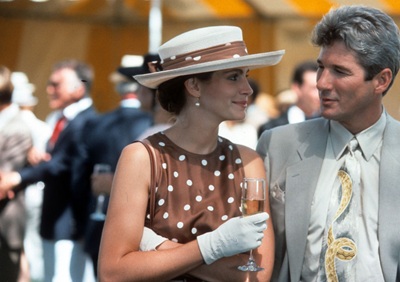
She designed six important outfits for Julia Roberts, including the brown-and-white polka dot dress she wore to the horse races, which was made from vintage silk found in a small antique fabric store in Los Angeles.
Every outfit — even Richard Gere’s suits — was carefully crafted to show the characters’ personalities.
Even Vivian’s shoes, like her Chanel heels, were thoughtfully selected to finish her stylish transformations.

Edward Lewis has some unique things in his wardrobe. The tie that Vivian buys for him in the store looks simple, but it actually changes knots in a sneaky way throughout the movie.
At the polo match, he wears it in a half-Windsor knot, but later on, it’s tied in a full-Windsor knot, and even his shirt collar style changes too.
These little mistakes are fun details for people who pay close attention.
When Edward shows Vivian the fancy life in Beverly Hills, he takes her on a shopping spree along Rodeo Drive.
Designer Marilyn Vance thinks that Vivian spent about $30,000 just in that scene.
From fancy dresses to jewelry, it’s a moment that really shows how overwhelming wealth and luxury can be.
The necklace that Vivian wears with her famous red dress is worth an incredible $250,000.
Made with real rubies and diamonds, the jewelry was protected by armed guards while they were filming, making sure it stayed safe.
This focus on being real added a touch of authenticity to the movie’s high-society moments.
The moment when the jewelry box snaps shut on Vivian’s fingers was originally intended as a gag.
Garry Marshall and Richard Gere played a prank on the young Julia Roberts, who occasionally arrived on set sleepy.
The box was soft, ensuring she wasn’t hurt, but her genuinely surprised and charming reaction was so perfect that it became part of the final film.
In another funny twist, when Vivian takes off Edward’s shoes after the opera, they magically show up again in the next scene.
Also, when Edward gives Vivian $100 and she hides it in her boot, the cash is gone later when she takes off her boots.
The four bright condoms Vivian shows Edward in another part of the movie also switch places between shots, proving that even little props can act on their own.
Even though the film helped Gere’s career, he admitted he wasn’t always satisfied with his character.
He called Edward “criminally underwritten” and joked that he was “just a suit with a good haircut.”
One scene, where Edward plays the piano while Vivian walks over, was made up on the spot. Director Garry Marshall asked Gere what he usually does late at night in a hotel, and the scene just flowed from that chat.
Even though Al Pacino was involved at first, Roberts really wanted Gere as her co-star and worked hard to get him to take the role. She even wrote him a note that said, “Please say yes.”
Gere later remembered this playful and sincere moment, which led to one of the most famous on-screen couples in movie history.
The chemistry between Roberts and Gere went beyond just acting. They became really good friends when the cameras weren’t rolling, chatting several times a day while they were filming and keeping in touch for many years after that.
Director Garry Marshall saw how well they got along right from the start, even when they were just hanging out without any cameras around.
Despite all its funny mistakes, continuity goofs, and pranks behind the scenes, Pretty Woman is still a classic movie.
The film is charming not just because of the love story but also because of its little flaws, the moments that weren’t planned, and the real connection between the stars.
It’s a film that still makes people happy even after many years, showing that charm, humor, and real human connections can make up for even the smallest errors.
Did we forget to mention your favorite blooper or behind-the-scenes story from Pretty Woman? Let us know, and let the magic of this timeless movie keep enchanting new audiences every year.