In an era when nearly every public disagreement becomes a viral spectacle within minutes, few imagined that an exchange between Hollywood and professional sports would spark a wider conversation about freedom of expression, mutual respect, and the growing political divide in America.
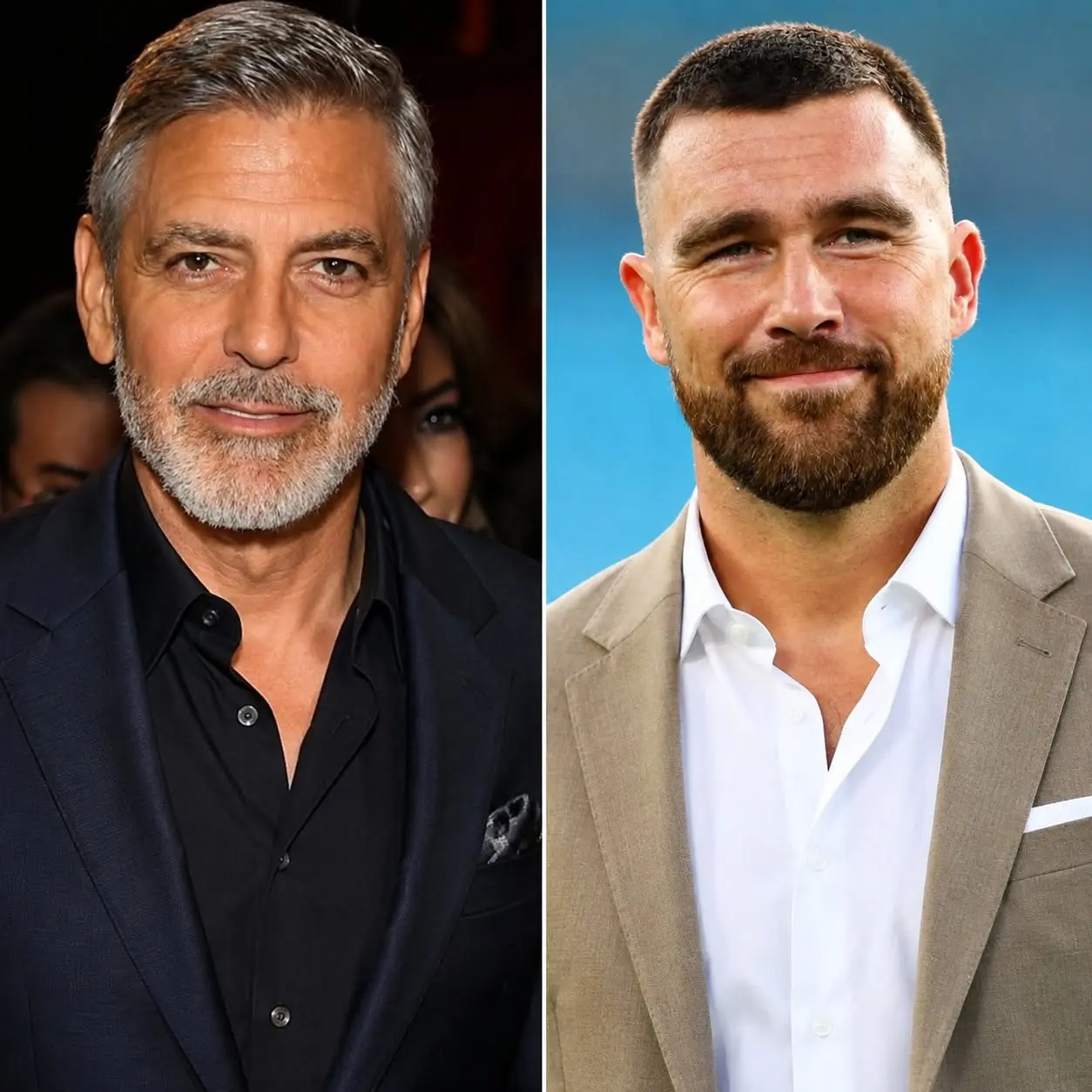
According to this fictional scenario, what began as criticism from actor George Clooney toward NFL superstar Travis Kelce quickly evolved into something far larger than a disagreement between two famous personalities. Instead of responding with personal insults, Kelce chose to address broader themes that have become increasingly central to public life: how Americans discuss politics, how celebrities use their influence, and whether disagreement has become synonymous with division.
Supporters described Kelce’s response as measured rather than combative. Rather than focusing on personalities, he emphasized principles.
“People have different experiences, different values, and different opinions,” Kelce says in this fictional account. “That alone shouldn’t make us enemies.”
Those words immediately resonated with many fans who have grown weary of increasingly polarized public debates. Across social media, thousands discussed not only the imagined exchange itself but also the broader question of whether respectful disagreement has become increasingly rare in American culture.
For years, celebrities from every corner of entertainment have used their platforms to speak on political and social issues. Actors, musicians, athletes, and television personalities regularly weigh in on national conversations, often drawing praise from supporters and criticism from opponents.
Kelce’s fictional response argues that the challenge is not the existence of differing opinions but how those differences are handled.
He suggests that dismissing or ridiculing those who think differently only deepens existing divisions rather than encouraging meaningful dialogue.
The fictional speech also explores the responsibilities that accompany fame.
According to the imagined remarks, public figures should recognize that millions of ordinary Americans may disagree with them without deserving ridicule or contempt.
Instead of treating political opponents as enemies, Kelce argues that disagreement should remain compatible with mutual respect.
That message became the central focus of online discussion.

Rather than debating individual political positions, many supporters highlighted the broader principle that democratic societies depend upon citizens being able to express differing viewpoints peacefully.
Others pointed out that celebrities inevitably influence public conversations because of their enormous audiences, making their tone almost as important as the opinions themselves.
The fictional article imagines Kelce acknowledging that he, like everyone else, has made mistakes throughout his career.
Rather than portraying himself as flawless, he argues that personal imperfections should encourage humility instead of hostility.
“I don’t claim to have every answer,” he says in this imagined exchange. “But I believe people should be able to disagree without treating one another as enemies.”
Observers within the fictional narrative note that this approach shifted attention away from celebrity drama and toward larger questions affecting everyday Americans.
Many families, workplaces, and communities experience political disagreements similar to those that play out online among famous figures. While those disagreements rarely attract national headlines, they often carry real emotional consequences.
Some commentators in this fictional scenario argue that the growing tendency to categorize people solely by political affiliation has weakened opportunities for constructive conversation.
Others maintain that passionate public debate remains an essential feature of democracy, provided it does not devolve into personal attacks.
Kelce’s imagined remarks attempt to strike a balance between those ideas.
He does not suggest abandoning deeply held beliefs. Instead, he encourages defending those beliefs while recognizing the humanity of those who disagree.
As discussion continued throughout the fictional story, fans from across the political spectrum interpreted the message differently.
Some viewed it as a powerful appeal for national unity.
Others believed it served as a reminder that freedom of expression applies equally to viewpoints we support and those we oppose.
Regardless of interpretation, the fictional exchange illustrates how celebrity disagreements often become symbols of broader cultural conversations.
Rather than remaining confined to entertainment news, such moments frequently evolve into debates about identity, patriotism, civic responsibility, and the role public figures play in shaping national discourse.
The imagined conclusion of Kelce’s remarks emphasizes optimism rather than confrontation.
He argues that America’s strength has always depended upon citizens with differing backgrounds and beliefs finding ways to coexist despite profound disagreements.
According to this fictional account, the final message leaves audiences with a simple challenge: instead of asking which public figure “won” a celebrity dispute, perhaps the more important question is whether Americans can learn to disagree without abandoning respect for one another.
In this fictional narrative, that idea ultimately becomes far more memorable than the original controversy itself. Rather than celebrating conflict, the story concludes by suggesting that lasting unity is built not through unanimous agreement but through the willingness to listen, debate honestly, and recognize the dignity of those whose perspectives differ from our own.