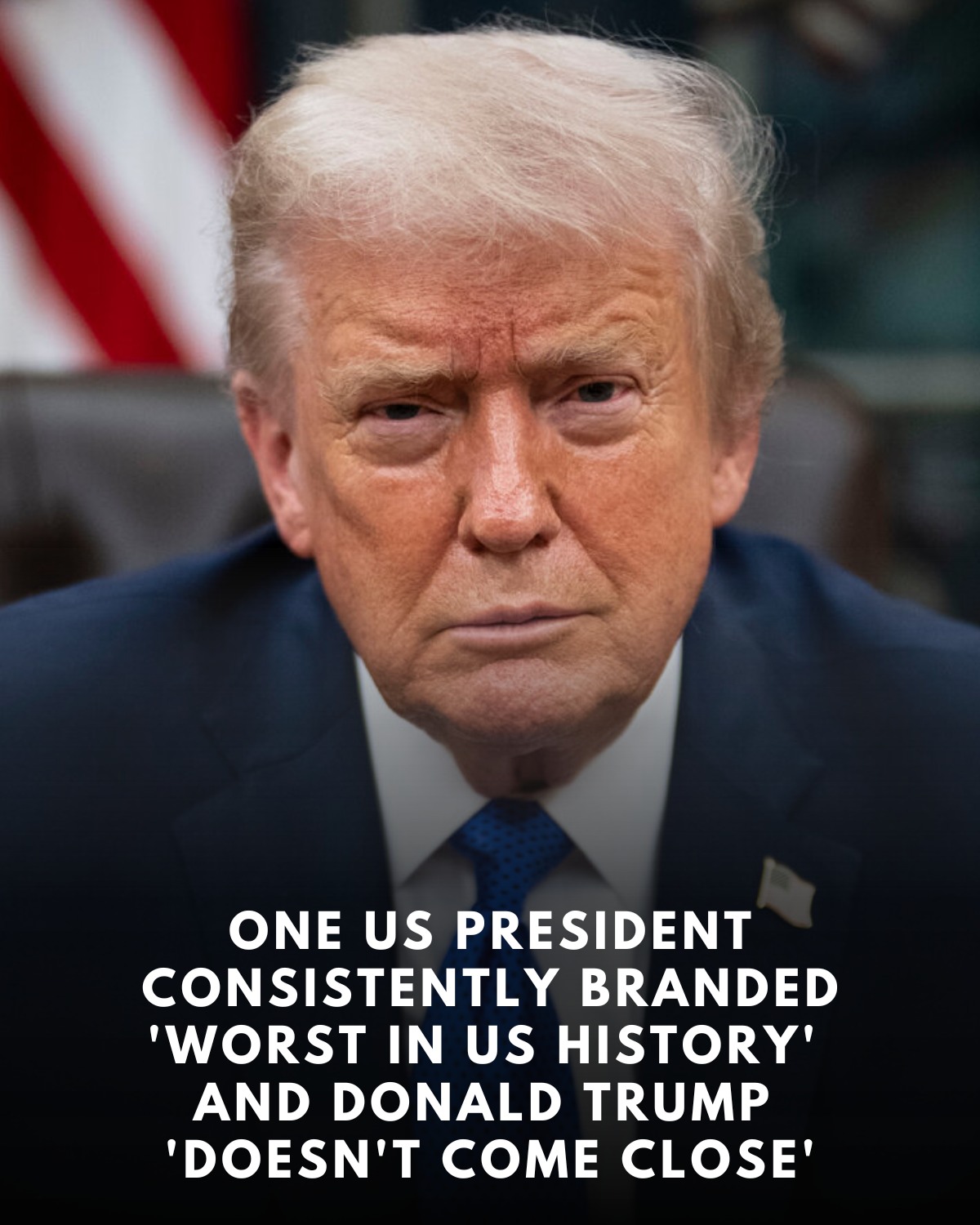
The suggestion that Donald Trump does not even come close to the worst presidency in American history points instead to James Buchanan, the 15th president of the United States, whose time in office from 1857 to 1861 is still treated by many historians as a case study in failed leadership at a moment of national emergency. Buchanan entered the White House as an experienced Democrat from Pennsylvania with a long public career behind him, having served in Congress, as minister to Britain and as secretary of state. Yet the administration he led is now remembered less for what it achieved than for how badly it misread the gathering storm over slavery and secession.
Buchanan won the presidency in 1856 after defeating Republican John C. Frémont and former President Millard Fillmore, arriving in office at a time when the United States was already deeply divided over whether slavery would spread into new territories. He presented himself as a figure who could calm sectional conflict, but his presidency quickly became bound up with decisions that inflamed it. In his inaugural address, he signalled that the territorial dispute over slavery would soon be settled by the Supreme Court, and within days the court issued the Dred Scott ruling, declaring that Black Americans were not citizens and that Congress lacked power to bar slavery from the territories. Historians have long viewed Buchanan’s posture around the case as one of the defining errors of his presidency, because it aligned the executive branch with a decision that intensified national outrage rather than settling the question.
His handling of Kansas caused further damage. The territory had already descended into violence in the years known as “Bleeding Kansas,” as pro-slavery and anti-slavery factions fought over its future. Buchanan backed the pro-slavery Lecompton Constitution even though it lacked broad support among settlers, putting himself at odds with many in the North, including members of his own party. Rather than acting as a stabilising force, he became identified with a process widely seen as unfair and partisan. That deepened distrust, split Democrats and added to the sense that the federal government was no longer capable of managing the slavery crisis through compromise.
Buchanan’s defenders have sometimes argued that any president in the late 1850s would have struggled. The country was moving toward a rupture that had been building for decades, and sectional bitterness had already worsened under his predecessors. But the criticism that has followed Buchanan for generations is not simply that he inherited an impossible situation. It is that, faced with a constitutional and moral crisis, he repeatedly chose passivity, misjudgment or open sympathy for Southern demands. The White House Historical Association notes that Buchanan described the territorial issue as being of little practical importance just before Dred Scott was handed down, a position that looked detached from reality even at the time.
The collapse of Buchanan’s standing is most clearly visible in the way historians rank him. Surveys of presidential scholars have for years placed him at or near the bottom of the list. C-SPAN’s 2017 survey of presidential historians ranked him last overall, with especially poor scores in crisis leadership, public persuasion, economic management, moral authority and vision. The same broad pattern appears across other historical assessments, which routinely place him among the worst presidents in US history, often alongside Andrew Johnson and Franklin Pierce. Even in an era when rankings are reshaped by arguments over modern presidencies, Buchanan has remained a fixture near the bottom because his name is tied so directly to the failure to prevent disunion before the Civil War.
The argument over whether Trump or Buchanan should be considered worse has become a political talking point in recent years because more recent surveys have ranked Trump last, beneath Buchanan. A 2024 survey of presidential experts placed Trump 45th, while Buchanan remained among the very worst presidents but no longer alone in the cellar. That result reflects how modern scholars weigh conduct, democratic norms and institutional damage, but it has not erased Buchanan’s historical reputation. Instead, it has sharpened the comparison between a president condemned by scholars for his role in the run-up to civil war and a modern president judged harshly for attacks on democratic norms and the aftermath of the 2020 election.
What keeps Buchanan’s name so firmly attached to failure is the way his presidency ended. After Abraham Lincoln won the 1860 election, Southern states moved toward secession. Buchanan denied that secession was lawful, but at the same time insisted that the federal government had no constitutional power to stop a state from leaving the Union. That position, to critics then and now, embodied the paralysis of his administration. At the very point when decisive leadership was most needed, Buchanan offered legal ambiguity, pleas for compromise and blame directed largely at Northern agitation rather than at the secessionists preparing to break the country apart. By the time he left office in March 1861, seven Southern states had already seceded.
Buchanan’s personal life has also added to the fascination around his legacy, though not in a way that changes the historical verdict. He remains the only US president never to marry, spending much of his life with close family members and, earlier in life, sharing a notably intimate friendship with Alabama senator William Rufus King. Those details have made Buchanan a subject of continued personal and biographical interest, but historians do not place his reputation where it is because of private life or personality. They place him there because his presidency coincided with the nation’s final slide toward war, and because his decisions are widely seen as having made that slide steeper.
The force of the modern claim about Buchanan lies in that record. Unlike presidents remembered mainly for scandal, corruption or incompetence in ordinary times, Buchanan is judged against the most serious test imaginable: whether he helped preserve the Union in the face of an existential crisis. The prevailing view among scholars is that he failed that test badly. He did not create the conflict over slavery, and he did not cause every event that followed, but he is remembered as the president who stood at the edge of catastrophe and proved unable, or unwilling, to meet it. That is why his name continues to surface whenever Americans argue over the worst presidency in the nation’s history. Even now, after years of fierce dispute over modern leaders, Buchanan remains the benchmark for presidential failure because his administration is inseparable from the collapse that came immediately after it.