In early 2026, an international political dispute involving the United States, the Kingdom of Denmark, and the Arctic territory of Greenland intensified into a significant diplomatic flashpoint.
The controversy — driven by statements and actions from then‑U.S. President Donald Trump regarding Greenland — has triggered strong reactions from political leaders, widespread public demonstrations, and a palpable strain in transatlantic relations.
Here is a thorough, factual account of what has happened, including major events, political reactions from Denmark and Europe, public opinion on Greenland’s future, and the viral incident involving a Danish politician’s rebuke of Trump.
What Is Greenland — and Why It Matters
Greenland is the world’s largest island, with a population of around 57,000 people. It is an autonomous territory within the Kingdom of Denmark, managing most of its internal affairs, while Denmark remains responsible for foreign policy and defense.
Strategically, Greenland holds enormous significance:
It sits between North America and Europe, along key Arctic military and shipping routes.
The region is believed to contain substantial natural resources, including rare earth minerals, oil, and gas.
It is a key location for military and radar installations, including U.S. defense facilities.
These factors make Greenland geopolitically valuable to global powers, especially the United States, Russia, and China.
Donald Trump’s Renewed Interest in Greenland
Former U.S. President Donald Trump — who was reelected and began a second term in 2025 — reignited his long‑standing interest in Greenland.
Trump has repeatedly framed the island as critical to U.S. national and global security, but his approach has been highly controversial.
Trump’s position has included:
Public calls for the United States to “acquire” Greenland — a phrasing that suggests either purchase or more direct control.
Threats of tariffs on European nations, including Denmark, if they did not agree to American terms on Greenland. For example, he threatened 10% tariffs on several EU members, escalating to 25% if control of the island was not granted.
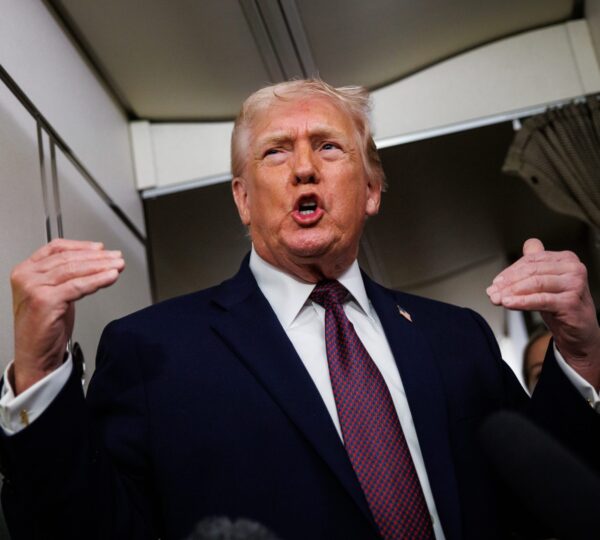
Statements that the United States might exert pressure if its security demands were not met.
However, Trump later denied intending to use military force and stated he would not pursue forceful annexation of Greenland.
At a speech during the World Economic Forum in Davos, he said that the U.S. was negotiating a “framework” for an agreement over Arctic cooperation and “total access” to Greenland, though the specifics remained undefined and contentious.
Even then, Danish and Greenlandic leaders continued to insist that sovereignty is non‑negotiable and that Greenland “is not for sale.”
Public Opinion in Greenland and Denmark
Contrary to some of Trump’s claims that Greenlanders might welcome joining the U.S., opinion polls and public sentiment paint a clear picture of opposition:
A recent poll showed that only a small fraction of Greenland’s residents support joining the United States, with a strong majority expressing opposition.
Public demonstrations under slogans like “Greenland is not for sale” have taken place in both Nuuk (Greenland’s capital) and Copenhagen (Denmark’s capital), with thousands participating.
The protests have become some of the largest in Greenland’s modern history, reflecting deeply held views about national identity and autonomy.
Danish and European Political Reaction
Political leaders in Denmark and across Europe have reacted strongly to Trump’s statements:
Danish Prime Minister Mette Frederiksen has repeatedly emphasized that Greenland — as part of the Danish realm — is not for sale and that Danish sovereignty must be respected.
Greenland’s own government has reaffirmed that any decisions affecting the island’s future must involve Greenlandic and Danish authorities and respect international law.
EU and NATO allies expressed concerns that threats of tariffs and coercive language could undermine trust and alliance relations.
French President Emmanuel Macron and other leaders framed the tariff threats as destabilizing, likening them to forms of pressure more associated with geopolitical rivals than long‑standing allies.
This tension has led to broader debates in European capitals about defense autonomy, NATO cooperation, and Europe’s strategic priorities.
Historic and Contemporary Demonstrations
In mid‑January 2026, a coordinated series of protests took place across Denmark and Greenland under the banner Hands off Greenland:
In Copenhagen, tens of thousands marched with banners reading “Greenland is not for sale.”
In Nuuk, thousands gathered to voice their opposition to any suggestion that Greenland’s status could be altered without the consent of its people and government.
Across Europe, solidarity movements called attention to concerns about territorial integrity and respect for democratic norms.
A Viral Moment: Danish Politician Responds in EU Parliament
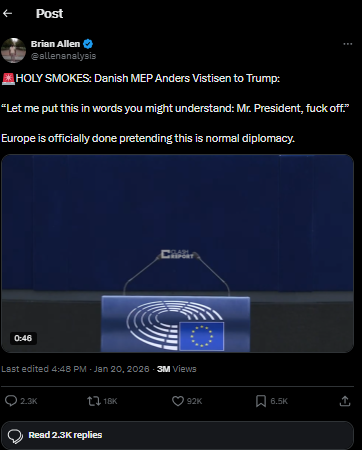
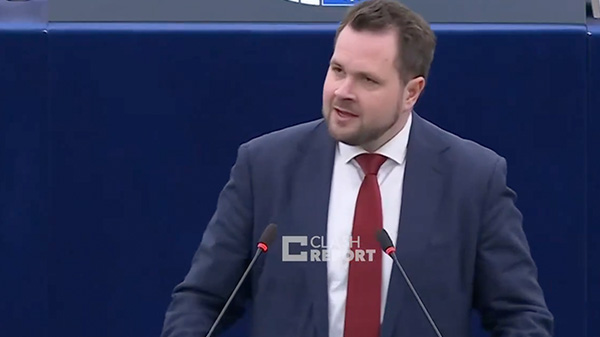
One of the most widely shared moments in this ongoing saga occurred in the European Parliament, where Anders Vistisen, a Danish Member of the European Parliament (MEP), directly addressed Donald Trump’s comments.

During a parliamentary session focused on Greenland, Vistisen made a blunt and highly news‑worthy statement.
While exercising his speaking time, he forcefully rejected the notion that Greenland could be “bought” or treated as a commodity, underscoring its long history as part of the Danish kingdom.
He said, in essence, that Greenland is “not for sale” and delivered a pointed message to the U.S. president that became viral on social media and in international news.
Because the language used violated parliamentary rules of decorum and conduct, the presiding official interrupted Vistisen, noting that such language was inappropriate in the legislative chamber.
The episode captured global attention — both praised by those who see it as defense of national sovereignty and criticized by others who felt the tone was too confrontational for a diplomatic setting.
Broader U.S. Public Opinion
Polls in the United States also reflected skepticism about Trump’s Greenland campaign:
A Quinnipiac University poll found majorities of U.S. voters opposed the idea of trying to buy Greenland.
Opposition was especially strong against any attempt to use military force to take control of the territory — with an overwhelming majority, including many Republicans, rejecting that option.
These figures suggest that American public opinion does not uniformly support the president’s approach to Greenland.
What This Means for Transatlantic Relations
The controversy over Greenland has broader implications for U.S.–European and NATO relations:
Long‑standing alliances between the United States and European nations — including Denmark — have been built on shared defense commitments, mutual economic ties, and common democratic values.
The Greenland debate, including threats of tariffs and incendiary rhetoric, introduced friction into these relationships.
Since the peak of this debate, there have been diplomatic efforts to reduce tensions:
Trump at times clarified that he would not pursue military action and suggested that the United States seeks a form of strategic access or cooperation rather than outright purchase.
Danish and Greenlandic officials continued to demand respect for the island’s autonomy and territorial integrity.
These exchanges underscore the challenges of balancing strategic interests with respect for the sovereignty of allied nations.
Concluding Perspective
The Greenland question — sparked by Donald Trump’s repeated public interest in acquiring political control or influence over the vast Arctic island — has become a touchstone for debates about sovereignty, international law, alliance relations, and the ethics of power politics.
Across diplomatic chambers, public squares, and international newsrooms, voices from Greenland, Denmark, Europe, and the United States have weighed in.
What began as a geopolitical position raised by an American president evolved into a broader discussion about national self‑determination, international cooperation, and mutual respect among allied nations.
The strong reactions from Greenland’s people and political leaders — as well as from Denmark and EU institutions — reflect deeply held commitments to autonomy and sovereignty that are central to modern democratic values.