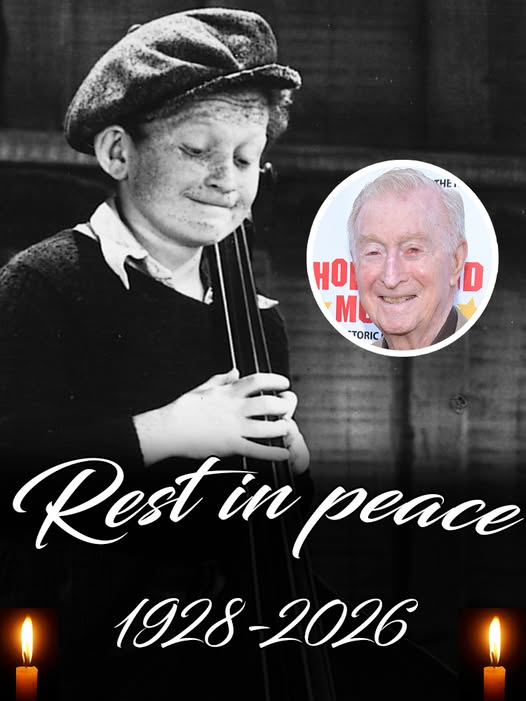
Sidney Kibrick, one of the most recognizable child actors of Hollywood’s early sound era and the final surviving member of the original Our Gang cast, has passed away at the age of 97. His death quietly closes a living chapter of film history—one that shaped generations of American humor and childhood nostalgia. According to his family, Kibrick died on January 3 at a hospital in Northridge, California, after a long life that extended far beyond his brief but memorable years on screen.
Born in Minneapolis in 1928, Kibrick relocated with his family to Los Angeles at a young age. Like many child performers of that era, his path into Hollywood was less the result of careful planning and more a matter of circumstance. He was discovered almost accidentally—simply a child in the right place at the right time—during a period when studios were constantly seeking young performers who could convey humor, charm, and relatability.
Kibrick became widely known through his appearances in the short comedy series Our Gang, later reintroduced to audiences as The Little Rascals. Created by producer Hal Roach, the series debuted in 1922 and ran for more than twenty years, depicting the everyday misadventures of children growing up in working-class communities. What set the series apart was its unusually natural portrayal of childhood—kids behaving like kids, complete with arguments, schemes, failures, and resilience—without the heavy sentimentality typical of studio productions of the time.
He joined the cast in 1935 at just five years old. His character, “Woim,” named after a Brooklyn-accented pronunciation of “worm,” was small in size but memorable in personality. Between 1935 and 1939, Kibrick appeared in roughly two dozen shorts, acting alongside future icons such as Carl Switzer, George McFarland, Darla Hood, and Tommy Bond. Together, they formed an ensemble that became deeply embedded in American popular culture.
Behind the scenes, however, the work was demanding. In later interviews, Kibrick spoke openly about the intense schedules faced by child actors at the time, when labor protections were still minimal. He recalled days that began with a brief period of schooling, followed by filming that could last anywhere from six to sixteen hours. Despite these challenges, he credited director Gordon Douglas with fostering an atmosphere that helped young performers deliver authentic, effective performances.
Financially, the job was remarkably lucrative for its time. Kibrick later shared that he earned approximately $750 per week during his years on Our Gang, an extraordinary amount during the Great Depression. Still, the income came with expectations and pressure—realities he only fully understood as he grew older. Like many former child stars, he carried both warm memories and complex feelings about that period of his life.
Beyond Our Gang, Kibrick appeared in several notable films. In 1938, he acted opposite Shirley Temple in Just Around the Corner, and in 1939 he appeared in Jesse James, starring Tyrone Power. While these roles broadened his experience, they also clarified that acting was not a lifelong ambition for him.
Although he left the spotlight early, his association with Our Gang never disappeared. Fans continued to recognize him, write letters, and invite him to conventions and retrospectives decades later. In 1981, Kibrick organized an Our Gang reunion, playing an active role in preserving the legacy of the series and the children who made it beloved. He remained generous with fans, speaking candidly about his experiences without relying solely on nostalgia.
In later years, Kibrick was frequently honored at events celebrating classic Hollywood and early cinema. In 2022, he attended the 100th anniversary celebration of Our Gang at The Hollywood Museum, where he was warmly welcomed as a living connection to a nearly vanished era of filmmaking. By then, he was the last surviving cast member from the 1930s shorts—a fact that underscored both his longevity and the passage of time.
Those who knew him personally describe Kibrick as a private, grounded individual who valued life beyond Hollywood. He never sought to revive his fame or aggressively monetize his past. Instead, he seemed content knowing his work had brought joy to millions, even if it represented only a small chapter of his life.
Sidney Kibrick’s passing marks more than the loss of an individual; it represents the end of a direct human link to early American film comedy. Our Gang lives on through archives, reruns, and cultural memory, but its creators now belong fully to history. Kibrick carried that legacy with humility, offering reflection rather than spectacle.
He is survived by his family and by generations of viewers who grew up laughing at black-and-white shorts that captured something timeless about childhood. His legacy is measured not by the length of his life, but by the enduring impact of his work. With his death, an era gently comes to rest—remembered for its simplicity, humor, and heart.