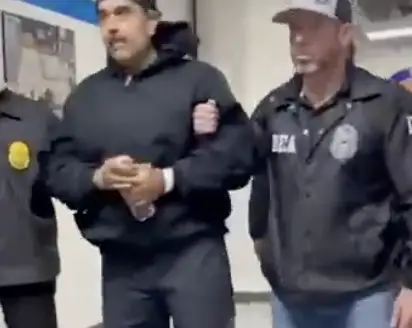
Video released by the White House’s rapid response account shows Venezuela’s president Nicolás Maduro in handcuffs being escorted through a US detention facility, where he turns briefly towards the camera and says: “Good night. Happy New Year.”
The footage has intensified an extraordinary diplomatic and legal confrontation after what US officials and major news agencies describe as a US Special Forces operation that seized Maduro in Caracas over the weekend and transferred him to detention in New York ahead of a federal court appearance on drug and narco-terrorism charges.
Maduro, 63, is expected to appear in Manhattan federal court alongside his wife, Cilia Flores, after both were jailed in Brooklyn following the raid, according to Reuters and the Associated Press. Prosecutors allege Maduro oversaw a state-backed cocaine trafficking network and coordinated with international criminal and militant organisations, accusations Maduro has repeatedly denied in the past.
The US case relies on a new indictment unsealed at the weekend and filed in the Southern District of New York, which sets out allegations that Maduro and senior figures around him participated in narcotics trafficking and weapons offences over a period spanning decades. In the charging document, prosecutors describe him as central to an alleged criminal enterprise that, they say, used state power and armed groups to protect trafficking routes, facilitate shipments and punish perceived enemies. “As Venezuela’s President and now de-facto ruler, Maduro allows cocaine-fueled corruption to flourish for his own benefit, for the benefit of members of his ruling regime, and for the benefit of his family members,” the indictment states.
The operation itself has become the focus of a parallel international dispute. Reuters reported that the raid knocked out power in parts of Caracas and struck military installations, and Venezuelan authorities said the action was deadly. Maduro’s allies, including Russia and China, have accused Washington of violating international law, while some US partners have urged restraint without directly condemning the United States.
At the United Nations, the legality of the seizure is set to be scrutinised by the Security Council, where Washington has veto power. The UN Secretary-General António Guterres, through his spokesperson, described the US operation as setting “a dangerous precedent,” and his office has called for respect for the UN Charter and international law.
The US has sought to frame Maduro’s capture as a response to transnational threats, arguing that he is not a legitimate head of state and that his alleged conduct endangers Americans. In remarks cited by Reuters, the US ambassador to the UN, Mike Waltz, invoked Article 51 of the UN Charter and said: “In this case, you have a drug kingpin, an illegitimate leader indicted in the United States, coordinating with the likes of China, Russia, Iran, terrorist groups like Hezbollah, pumping drugs, thugs, and weapons into the United States of America, threatening to invade its neighbors.”
But legal scholars quoted by Reuters dispute that justification, arguing the raid lacked a lawful basis because it had no authorisation from the Security Council, no consent from Venezuela and did not meet the threshold for self-defence against an armed attack. “The action violated international law,” Tom Dannenbaum, a professor at Stanford Law School, told Reuters. “Serious legal objections to Maduro’s regime do not eliminate the need for a legal basis to use military force in Venezuela.”
Other experts warned that even if allegations against Maduro were true, narcotics trafficking would not qualify as an armed attack under international law and would not permit unilateral military action. Reuters also quoted Adil Haque, a professor at Rutgers Law School, as saying the capture “was an illegal infringement of the inviolability and immunity of a sitting Head of State, who may lack democratic legitimacy but was clearly effectively discharging his official functions on behalf of his State.”
The confrontation lands in a Venezuela already destabilised by years of political crisis, economic collapse and mass emigration. Maduro rose to power as the chosen successor of Hugo Chávez, a former military officer whose “Bolivarian” movement reshaped Venezuela’s institutions and politics. A former bus driver and trade union organiser, Maduro served as foreign minister and vice president before winning the presidency after Chávez’s death. He has remained in power through waves of protests, international sanctions and repeated disputes over election legitimacy.
The United States and several other governments have for years refused to recognise Maduro as Venezuela’s lawful leader, citing elections they argue were conducted without basic guarantees. That posture is likely to be central to Washington’s argument that he should not be treated as a protected head of state for the purposes of immunity. Defence lawyers, however, are expected to argue that sovereign immunity applies regardless of whether Washington recognises Maduro politically, a dispute that could shape whether the case can proceed on its merits.
The indictment described by Reuters alleges Maduro’s involvement from the time he entered national politics in 2000, continuing through his tenure as foreign minister and during more than a decade in the presidency. Prosecutors claim he directed trafficking routes, used military forces to protect shipments, and sheltered violent criminal groups, allegations that would be tested by evidence and witnesses in court.
The case also raises the question of how far the United States is willing to go to pursue foreign leaders it accuses of major crimes. Reuters noted that Washington’s move has been described as the most controversial US intervention in Latin America since the 1989 invasion of Panama, which ended with the capture of Manuel Noriega, a former Panamanian leader later prosecuted in the United States on drug charges.
For Venezuela, the immediate political fallout remains uncertain. Reuters reported that the removal of Maduro could lead to further instability in a country of around 28 million people already fractured between competing political factions and security forces with divided loyalties. The government apparatus built under Chávez and Maduro has relied heavily on military leadership and security services, while opposition groups have struggled to translate public discontent into a durable change of power.
Diplomatically, the UN debate is likely to sharpen pressure on governments to state plainly whether they consider the raid lawful or not. Even if no Security Council action results, the dispute may leave a long shadow over norms of sovereignty and the treatment of sitting leaders, particularly when powerful states claim extraordinary threats. As Guterres’s office put it in its warning over the weekend, the US action constitutes “a dangerous precedent.”