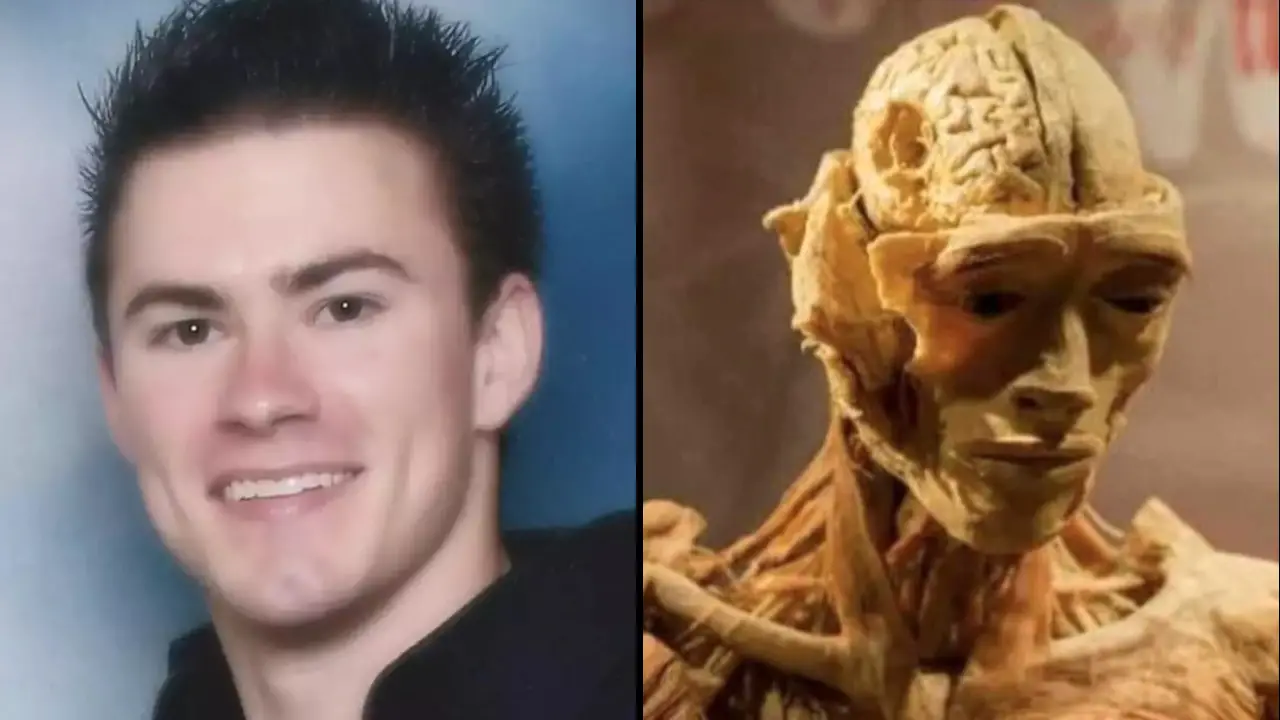
A museum has responded after a mom claimed she ‘discovered her son’s dead body on display.’
A Las Vegas museum has issued a statement after a Texas mother publicly claimed that a plastinated cadaver in its Real Bodies exhibition is actually the remains of her son, a man whose 2012 death has long been surrounded by unanswered questions.
Kim Erick, 54, says she was ‘shaken to the core’ when she walked through the Real Bodies exhibit in Las Vegas and saw a skinned, dissected specimen posed as part of the show.
The mother says the figure bore ‘an unmistakable resemblance’ to her son, 23-year-old Chris Todd Erick, who died under mysterious circumstances more than a decade ago.
“I knew it was him the moment I saw it,” she told The Sun. “It was unbelievably painful. My family and I were devastated all over again. It felt like I was staring at photos of my son’s skinned, butchered body.”

Chris died in 2012 at his grandmother’s home in Midlothian, Texas.
At first, police told the family he had suffered two sudden heart attacks linked to a heart defect.
Days later, his body was viewed briefly at a funeral home before, according to Kim, her ex-partner handled the cremation arrangements.
She received a necklace said to contain a small amount of her son’s ashes, but she claims no funeral ever took place.
Haunted by doubt, Kim requested the police file and says the scene photographs showed extensive bruising, lacerations and what she believed to be dry cyanide residue around Chris’s lips.
Kim said the images also depicted a chair fitted with straps that she felt matched marks on her son’s torso and arms.
After pushing investigators for further analysis, a medical examiner re-tested a vial of Chris’s blood and detected a lethal concentration of cyanide.
His cause of death was changed from natural causes to cyanide toxicity — and eventually ruled a suicide by ‘undetermined means.’ A 2014 grand jury reviewed the case but found no evidence of foul play.
Still, Kim remained convinced her son was murdered. “Nothing made sense,” she said. “I knew my son, and I knew he would not take his own life.”

Years after Chris’s death, Kim came across media coverage of the Real Bodies exhibit, a controversial show featuring more than 20 preserved human cadavers and hundreds of anatomical specimens.
One of the plastinated bodies, nicknamed The Thinker, stopped her cold. She believed she recognized specific physical features, including a frontal skull fracture similar to one she claims she saw in her son’s autopsy photos.
She also insists that the cadaver’s shoulder showed evidence that a tattoo had been deliberately removed.
“Chris had a tattoo in that exact spot,” she said. “The only way it wouldn’t show is if the skin itself had been cut away.”
Kim says she contacted the exhibit repeatedly, urging administrators to conduct DNA testing on the specimen.
She claims the body later disappeared from the Las Vegas display and was rumored to have been sent to a Tennessee location, though she says no record of its arrival exists.

Imagine Exhibitions, the company that operates Real Bodies, strongly refutes Kim’s allegations.
In responses to The Sun and fact-checking site Lead Stories, the company stated: “We extend our sympathy to the family, but there is no factual basis for these claims. The specimen in question has been on continuous display in Las Vegas since 2004 and cannot be associated with the individual named.”
The company emphasized that all cadavers and anatomical materials in the show are ‘ethically sourced’ and ‘biologically unidentifiable,’ adding that Real Bodies adheres to ‘the highest ethical and legal standards.’
Kim says she rejects the museum’s explanation.
She continues to search for what happened to her son’s remains and is now looking into whether his body could be among 300 unidentified piles of cremated human remains discovered in the Nevada desert earlier this year.
Investigators have not determined where the ashes originated.
“I just want them tested,” Kim said. “If there’s even a chance my son is among them, I need to know. Chris was never abandoned in life, and I refuse to let him be abandoned in death.”
As of now, no physical evidence has publicly linked Chris Erick to the plastinated cadaver, and the museum maintains the claim is impossible. But for Kim, the pursuit of answers remains relentless more than 13 years after her son’s death.
“I don’t want any other family to experience what mine has lived through,” she said. “I just want the truth.”