The show didn’t just entertain; it changed the game for female heroes.
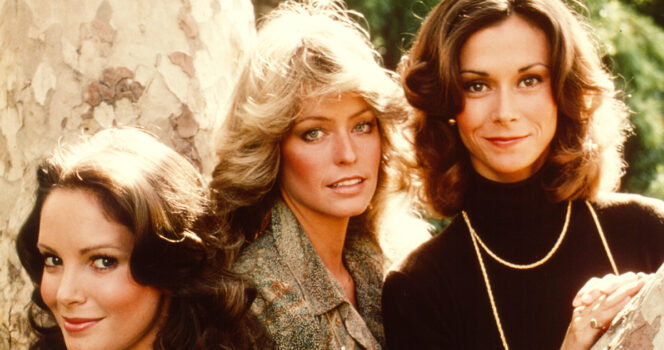
Farrah Fawcett, Kate Jackson, and Jaclyn Smith weren’t just solving crimes; they were breaking down barriers, showing that women could be smart, strong, and stylish all at the same time.
Charlie’s Angels was more than just exciting mysteries and daring adventures. Farrah, Kate, and Jaclyn became symbols of empowerment, encouraging a whole generation to rethink what women could do, both on screen and in real life.
And we can’t forget about the fashion — those stylish outfits weren’t just costumes; they made a statement, shaping trends and pop culture in ways no one saw coming.
Even though critics had mixed feelings and called it “jiggle television” for focusing on the sex appeal of its female stars, Charlie’s Angels still made it into the Nielsen top ten during its first two seasons.
I’ve mostly watched reruns of this iconic show over the years, but recently, I decided to explore more and find out what really happened behind the scenes of this cult classic. And guess what — there are tons of funny bloopers, unexpected moments, and surprising stories that you probably didn’t know about.
For anyone who might have missed this cult classic, here’s a quick summary: Charlie’s Angels follows the crime-fighting adventures of three women who work at a private detective agency in sunny Los Angeles. The original trio — Kate Jackson, Farrah Fawcett, and Jaclyn Smith — starred in the show, while the voice of their mysterious boss, Charlie Townsend, came through a speakerphone, guiding their missions.
Now, here’s a fun behind-the-scenes fact about Charlie himself. John Forsythe wasn’t the first choice to voice the boss. The original actor, Gig Young, was dropped at the last minute because of a drinking issue. Forsythe stepped in and ended up recording his first voice-over while wearing his pajamas.
Throughout the whole series, Forsythe never actually appeared on set. All his lines were recorded separately and added in later. He even told the show’s producer, Aaron Spelling, that if he were to show up on screen, it would cost a lot of money. To keep the illusion alive, whenever Charlie was ‘seen,’ it was actually just a stand-in shot from behind or from far away.

Here’s a funny mistake you might not have noticed, even if you’ve watched Charlie’s Angels many times. Every time a new scene begins at the Townsend Agency, they show the same view of the building with the Angels’ cars parked outside. But—if you’re really looking — the cars outside hardly ever match which Angels are actually inside in the next scene.
And here’s the funny part: whenever all three cars are shown, they’re almost always parked in the same order from left to right — white, yellow, and orange. Pretty consistent, right? Well… not really. The white and orange cars are always parked in no-parking zones, and there’s only one parking meter for all three spots. So either the Angels had some serious connections, or the parking department just ignored the rules for crime-fighting fashionistas.
Oh, and if you were curious about those cool cars? Each Angel had her own special Ford. Jill (and later Kris) drove a flashy Cobra, Kelly kept it chill in a Mustang, and Sabrina drove a Pinto like the boss she was. And we can’t forget Bosley — he showed up in a Thunderbird, of course.
When Charlie’s Angels first came on TV, Farrah Fawcett and Jaclyn Smith were just starting out in acting — and their salaries reflected that. Both were earning only $5,000 per episode. Meanwhile, Kate Jackson, the more experienced one of the group, was making double that at $10,000.
But things changed — especially for Jaclyn Smith.

As the only Angel to stay with the show for all five seasons, Smith’s salary increased right along with the show’s success. By the time the last season aired, she was making an incredible $75,000 per episode, which placed her among the highest-paid TV stars of that era.
Only four major stars earned more than her: Carroll O’Connor (All in the Family), Alan Alda (MASH*), Larry Hagman, and Linda Gray (both known for Dallas).
Believe it or not, the famous show Charlie’s Angels almost had a very different and kind of awkward name: Alley Cats. Yep, that was the original title being considered, even though it had nothing to do with the stylish, crime-fighting women at the center of the series. And let’s be honest… the name didn’t really sound like “classy detectives.”
Luckily, Kate Jackson came to the rescue. While she was in Aaron Spelling’s office, she saw a painting of three angels on the wall. That’s when she got the idea — and she proposed the name Charlie’s Angels instead.
Thanks to that moment, the show became a pop culture icon, creating a legacy that’s still going strong today through reruns, DVD collections, reboots, and a full movie franchise that started in 2000.
Why Farrah Fawcett really left
When Charlie’s Angels first aired in 1976, Farrah Fawcett wasn’t just one of the stars; she was the sensation. Her iconic red swimsuit poster was everywhere, and her feathered blonde hair became the hairstyle of the decade. Fans were obsessed with her. The media couldn’t get enough. But then, just one season in, she shocked everyone: Farrah was out.
So why did Farrah Fawcett leave one of the biggest shows on TV? The answer is complicated, involving money, marriage, ambition, and a strong desire for more than just fame.
When you look at pictures from the set with all the Angels together, they often seem happy and cheerful, but behind the scenes, things were definitely more complex.
Farrah’s sudden rise to fame overshadowed her co-stars Kate Jackson and Jaclyn Smith. According to the Washington Post, she was up for a raise to $10,000 per episode, but there were rumors that she wanted $75,000. On top of that, she reportedly asked for 10% of the show’s merchandising profits. However, the producers weren’t getting any clear signals from her.
“I would say, ‘Well, Farrah, if we give you eight percent?’ and she would reply, ‘Well, no, I don’t know,’” producer Leonard Goldberg recalled to Vanity Fair. It seemed like she didn’t want to negotiate at all.
Honestly, Farrah was aiming for something bigger than just a paycheck from TV. Back in early 1977, she shared with the Washington Post that her dream was to create a movie that captured real women’s feelings. Her co-star Jaclyn Smith later mentioned that Farrah really wanted to work on films instead of just a TV series.
Farrah and her husband at the time, Lee Majors, even started their own production company called Fawcett-Majors Productions. The producers of the show tried to convince her to stay by offering her a deal: if she continued with Angels, they would also let her star in a movie. She decided to turn it down.
Farrah felt like she was in a creative rut. Although the show was famous for its glamour and action, she wanted to express more depth — more sadness, more emotion.
“I want them to start showing she’s had some hard times, too, and cries, and is sad,” she told The Washington Post. “Who’s gonna care about her if all she does is say, ‘Ooo! This week I get to play the hooker?’”

She even confessed that the show’s success probably wasn’t really about acting. “When the show hit No. 3, I thought it was our acting. But when it reached No. 1, I realized it must be because none of us wore a bra.”
In the end, she was very straightforward: “Creatively, I just felt trapped. So, it was time for me to go.”
“I felt weird when suddenly I was getting more attention and fan mail than Jaclyn Smith or Kate Jackson,” she shared with People in 1981. “I sensed a change in them, not on the outside, but inside. We never fought, but I felt a bit of a wall between us.”
Wherever she went, fans crowded around her. Her fame became overwhelming. “I became successful before I was ready or knew what I was doing,” she admitted. “The success came before I had done what I thought was a good role.”
She realized one thing: “If I wanted to stay in the business, I had to change — and I wanted to change.”
Farrah’s departure wasn’t easy. Jaclyn Smith openly criticized her for leaving, saying, “I didn’t think it was the right thing to do. I mean, you have a contract.” But Farrah stood her ground, insisting: “It’s a well-generated myth that I was breaking a contract.”
Still, lawsuits came next. The producers sued her for breaking the contract, leading to a tense legal fight.
The legal struggle finally ended when Farrah Fawcett agreed to come back for six guest spots on Charlie’s Angels, which kept airing until 1981. But leaving the show cost her a lot in her career. According to Fawcett, her choice to leave meant she missed out on other chances in Hollywood.
“The whole lawsuit almost ruined me,” she confessed in a 1979 interview with People.
“The industry was really mad at me and unfriendly because I was a TV sex symbol who wanted to be an actress. People thought I was really full of myself, and for months, no one wanted to work with me.
After Farrah Fawcett’s departure following the first season, Cheryl Ladd stepped in, bringing her own energy and charm. She joined as Kris Munroe, the sister of Farrah’s character.
On Cheryl Ladd’s very first day on set, she broke the ice by wearing a custom T-shirt that read “Farrah Fawcett Minor” — a cheeky nod to the big shoes she had to fill.

Similarly, when Kirstie Alley joined the cast of Cheers, she made a memorable entrance by dressing in a bold pink power suit, sporting a big blonde wig just like Shelley Long, and playfully acting all prim and proper. Her fun approach instantly won over the cast and crew, making her a hit from day one.
The show’s early seasons were a hit, ranking among the top 10 most-watched programs. But as the 1980s rolled in, Charlie’s Angels started to lean more on glamour and less on substance, and viewers began to drift away. The final episode, “Let Our Angel Live,” closed the chapter on what had been a groundbreaking journey.
Yet, the legacy refused to fade. The story was revived with a splash on the big screen, featuring Cameron Diaz, Drew Barrymore, and Lucy Liu — modern Angels who carried the torch forward with fiercer action and a fresh cultural vibe.

The 2011 reboot tried to capture the magic again but faltered, ending after just seven episodes. Then in 2019, Kristen Stewart, Ella Balinska, and Naomi Scott took on the roles, but the series struggled to win over old and new fans alike.
Despite the ups and downs, Charlie’s Angels remains a powerful symbol of female strength and independence.
It challenged stereotypes, opened doors for women in action roles, and showed the world that femininity and toughness are not mutually exclusive. For countless viewers, the Angels weren’t just characters on TV — they were trailblazers, role models, and proof that women could shine brightly in a world that was just beginning to recognize their power.
The original Charlie’s Angels lineup from the 1970s captured hearts around the world and left a lasting legacy in TV history.
Here’s a quick look at the fates of the iconic Angels:
Jaclyn Smith (born October 26, 1945) — Jaclyn is the only Angel who appeared in all 110 episodes, and she is still alive and doing great. She opened doors for women in leading roles on TV with her character Kelly Garrett.
Cheryl Ladd (born July 12, 1951) — The actress who took over for Farrah Fawcett as Kris Munroe is also alive and doing well, and she is still involved in acting and music.
Shelley Hack (born July 6, 1947) — Shelley came on board in season 4 and is living a fulfilling life as both an actress and a producer.
Tanya Roberts (October 15, 1949 – January 4, 2021) — Tanya sadly passed away at the age of 71 due to complications from a urinary tract infection, just after being mistakenly reported dead.
If you grew up loving Charlie’s Angels or just want to pay tribute to them, share this message and keep their memory alive!