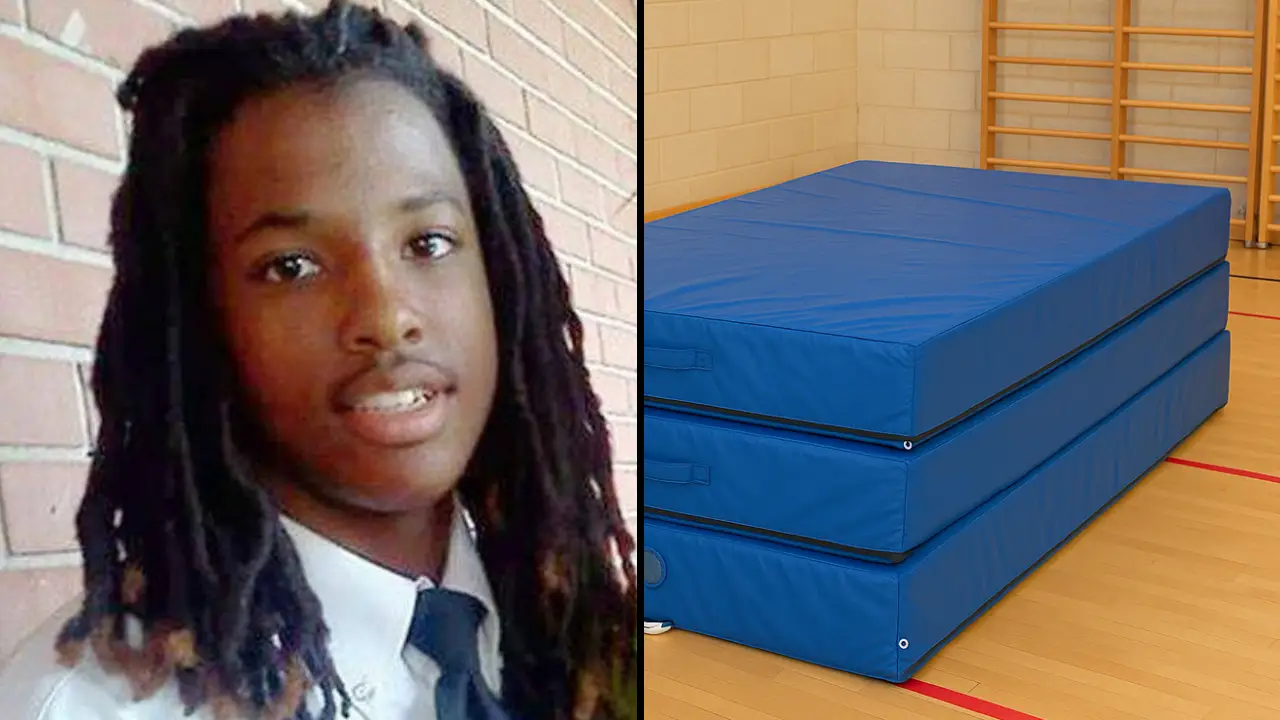
The body of teenager Kendrick Johnson was discovered in a shocking and unusual circumstance inside a school gym mat.
The tragic discovery has led to years of controversy, multiple investigations, and ongoing legal battles over what really happened to the promising young athlete.
Fellow students made the grim discovery when they climbed to the top of a cluster of gym mats standing nearly six feet tall.
Johnson was found headfirst in the center of a vertically positioned mat, with his shoes wedged behind his knees.
The mat had a 14-inch diameter opening in its center, while Johnson’s shoulders measured 19 inches across.
“Kendrick was a really, really great son,” said his father, Kenneth Johnson, to 41 NBC. “And, you know, everyone in our family really misses him.”

Authorities quickly ruled the death accidental. The Georgia Bureau of Investigation’s autopsy concluded that Johnson died from positional asphyxia, suffocating after becoming trapped upside down in the mat.
Investigators theorized that Johnson had fallen into the mat while reaching for a shoe, with three students telling investigators it was common practice for students to store shoes behind or under the rolled-up mats to avoid paying for lockers.
Lieutenant Stryde Jones, who headed the investigation for the Lowndes County Sheriff’s Office, stated per the Huffington Post: “We never had credible information that indicated this was anything other than an accident.”
The case was officially closed within four months of Johnson’s death.
Johnson’s family remained unconvinced by the official explanation. They raised concerns about several troubling aspects of the case, including gaps in surveillance footage and the fact that the county coroner wasn’t notified until six hours after the body was discovered, a violation of Georgia state law requiring immediate notification.
The family hired an independent pathologist, William R. Anderson, to conduct a second autopsy in June 2013.
This examination reached a dramatically different conclusion, finding evidence of blunt force trauma to Johnson’s neck and suggesting the death was not accidental.
The second autopsy revealed another shocking detail: Johnson’s internal organs were missing, and his body had been stuffed with newspaper.
The funeral home stated they never received the organs from the coroner, while the coroner claimed the organs had been ‘destroyed through natural process’ and discarded, CNN reports.

In October 2013, the U.S. Attorney for the Middle District of Georgia announced a formal review of the case. The investigation lasted nearly three years, with federal investigators interviewing close to 100 people.
However, on June 20, 2016, the Department of Justice announced no criminal charges would be filed, stating there was ‘insufficient evidence to prove beyond a reasonable doubt’ that anyone violated Johnson’s civil rights.
The Johnson family filed a $100 million civil lawsuit in 2015 against 38 individuals, including school officials, local and state investigators, and federal agents.
The lawsuit alleged Johnson was murdered and that respondents engaged in a conspiracy to cover up the homicide.
The lawsuit was ultimately dismissed, and in August 2017, Georgia Judge Richard Porter ordered the Johnson family and their attorney to pay more than $292,000 in legal fees to the defendants, stating they had ‘no evidence to support their claims.’
One of the most controversial aspects of the case involves surveillance footage from the gym.
When 290 hours of tape from 35 cameras were released in November 2013, a forensic analyst found that footage from multiple cameras was missing significant time periods, including one hour and five minutes from two cameras and two hours and ten minutes from another.
Investigators later explained some gaps were due to unsynchronized camera systems and motion-activated recording functions. The area where Johnson’s body was found was not covered by any cameras.

In March 2021, Lowndes County Sheriff Ashley Paulk reopened the investigation, even offering $500,000 of his own money as a reward for information.
After 13 months of review, Paulk closed the case in January 2022, concluding per KARE 11: “There was no homicide, no coverup, no conspiracy in the January 2013 death of the teen. It was simply a tragic and bizarre accident.”
More than twelve years after their son’s death, Kenneth and Jacquelyn Johnson continue their fight.
In August 2025, they filed an amended $12 million lawsuit against the Georgia Department of Public Health, demanding the cause of death on their son’s official death certificate be changed from ‘accidental positional asphyxia’ to ‘non-accidental blunt force trauma.’
“We have filed the right paperwork,” Kenneth Johnson said. “We have filed several different times to get his death certificate corrected.”
The lawsuit also raises concerns about racial bias in how the case was handled. “If Kendrick was white, his family wouldn’t be going through this right now,” Johnson said. “But since it’s a Black child, these people don’t care. But we care. And we will push for the truth.”
Johnson’s mother, Jacquelyn, described the ongoing pain: “We can’t even really begin to grieve or mourn because of the fight we’ve had to endure.”
The Guardian has called Kendrick Johnson ‘our generation’s Emmett Till’ – a reference to the 1955 lynching that became a catalyst for the civil rights movement.
Despite multiple autopsies, federal investigations, and numerous legal proceedings, the question of exactly what happened to Kendrick Johnson in that Valdosta gymnasium remains a source of controversy.