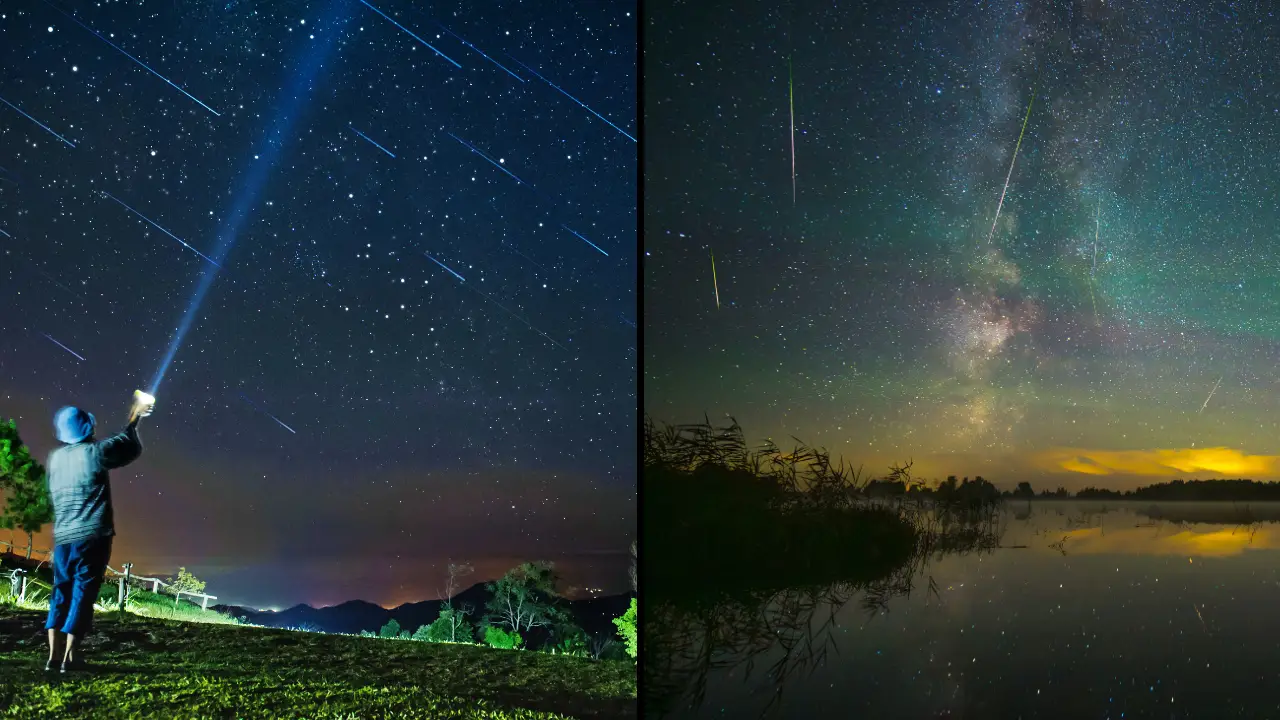
The Perseid meteor shower begins tonight with up to 100 shooting stars per hour.
Stargazers are in for a celestial treat this week as the Perseid meteor shower reaches its spectacular peak, promising one of the most dazzling displays of shooting stars visible all year.
The annual Perseid meteor shower, widely regarded as the ‘most popular meteor shower of the year’ by NASA, is set to light up the night sky with potentially 100 meteors per hour under ideal conditions.
While this year’s viewing may be hampered by bright moonlight, astronomy experts are still encouraging people to venture outside for what promises to be an impressive cosmic light show.
The Perseid meteor shower occurs when Earth passes through the debris trail left behind by Comet 109P/Swift-Tuttle, which orbits the Sun once every 133 years, per Space.com.
The comet last visited our inner solar system in 1992, but continues to provide this annual spectacle as our planet plows through the dust and particles it left in its wake.
These tiny fragments, most no bigger than grains of sand, enter Earth’s atmosphere at incredible speeds of up to 37 miles per second.
The friction with our atmosphere causes them to burn up in brilliant streaks of light that can last several seconds, creating the magical ‘shooting star’ effect that has captivated humanity for millennia.

Dr Ashley King, a meteorite expert from London’s Natural History Museum, explains the phenomenon to Sky News: “As they come out of the vacuum of space and into Earth’s atmosphere, that little dust grain interacts with all the particles and ions in the atmosphere.
“It gets heated up by the friction and forms the impressive flash that we see.”
The Perseids have been active since July 17 and will continue until August 24, but tonight marks the absolute peak of activity.
The best viewing time will be between midnight and dawn on August 13, with the optimal window falling between 1 and 5 a.m. local time.
For those who prefer earlier viewing, meteors can be spotted as early as 10 p.m., particularly the spectacular ‘earthgrazers’ – meteors that skim along our atmosphere and create longer, more dramatic trails across the sky.
The meteors appear to radiate from the constellation Perseus in the northeastern sky, which is how the shower gets its name.
However, meteors can appear anywhere in the sky, so observers should look straight up and take in as much of the night sky as possible.

Comet Swift-Tuttle, at 26 kilometers wide, is the largest solar system object to regularly pass relatively close to Earth – though thankfully, calculations show it poses no threat to our planet, the National History Museum shares.
The comet’s elongated orbit means the debris enters Earth’s atmosphere at tremendous velocity, creating the fast-moving, bright meteors that make the Perseids so spectacular.
Unlike some other meteor showers that occur during colder months, the Perseids benefit from occurring during summer when skies are often clearer and weather more accommodating for outdoor observation.
Unfortunately, viewing conditions won’t be perfect this year. The peak coincides with a waning gibbous moon that’s approximately 84-88% illuminated, which will wash out many of the fainter meteors.
Robert Lunsford from the American Meteor Society warns that the best rates will probably be near 15 per hour as dim meteors make up a majority of the activity, per Earth Sky.
However, he emphasizes that the Perseids are known for producing bright meteors and spectacular fireballs that should still be visible despite the moonlight.

Astronomy experts recommend several strategies to maximize your viewing experience, per Science Focus.
Find the darkest location possible – Get away from city lights and light pollution. Rural areas, hilltops, or coastal locations offer the best viewing opportunities.
Position yourself strategically – Face northeast and keep the moon at your back or blocked by a building or tree to reduce glare.
Be patient – Allow your eyes 20-30 minutes to fully adapt to the darkness. Avoid looking at bright lights or phone screens, which will reset your night vision.
Get comfortable – Bring a blanket or reclining chair to lie back and scan the entire sky without getting a stiff neck.
Use red light only – If you need illumination, use a red-filtered flashlight or put your phone in red light mode to preserve your dark adaptation.
Dress warmly – Even in August, temperatures can drop significantly during the pre-dawn hours.
Early morning observers on August 13 may catch an additional treat: Jupiter and Venus will appear at their closest approach of the year, shining brightly as the two most luminous objects in the pre-dawn sky after the Moon.
For those unable to catch tonight’s peak, the Perseid shower remains active for several more days, though meteor rates drop significantly after the peak.
As Lunsford notes: “Rates fall by 50% each night after the peak, so by the time the moon is out of the way, there is little left to watch.”