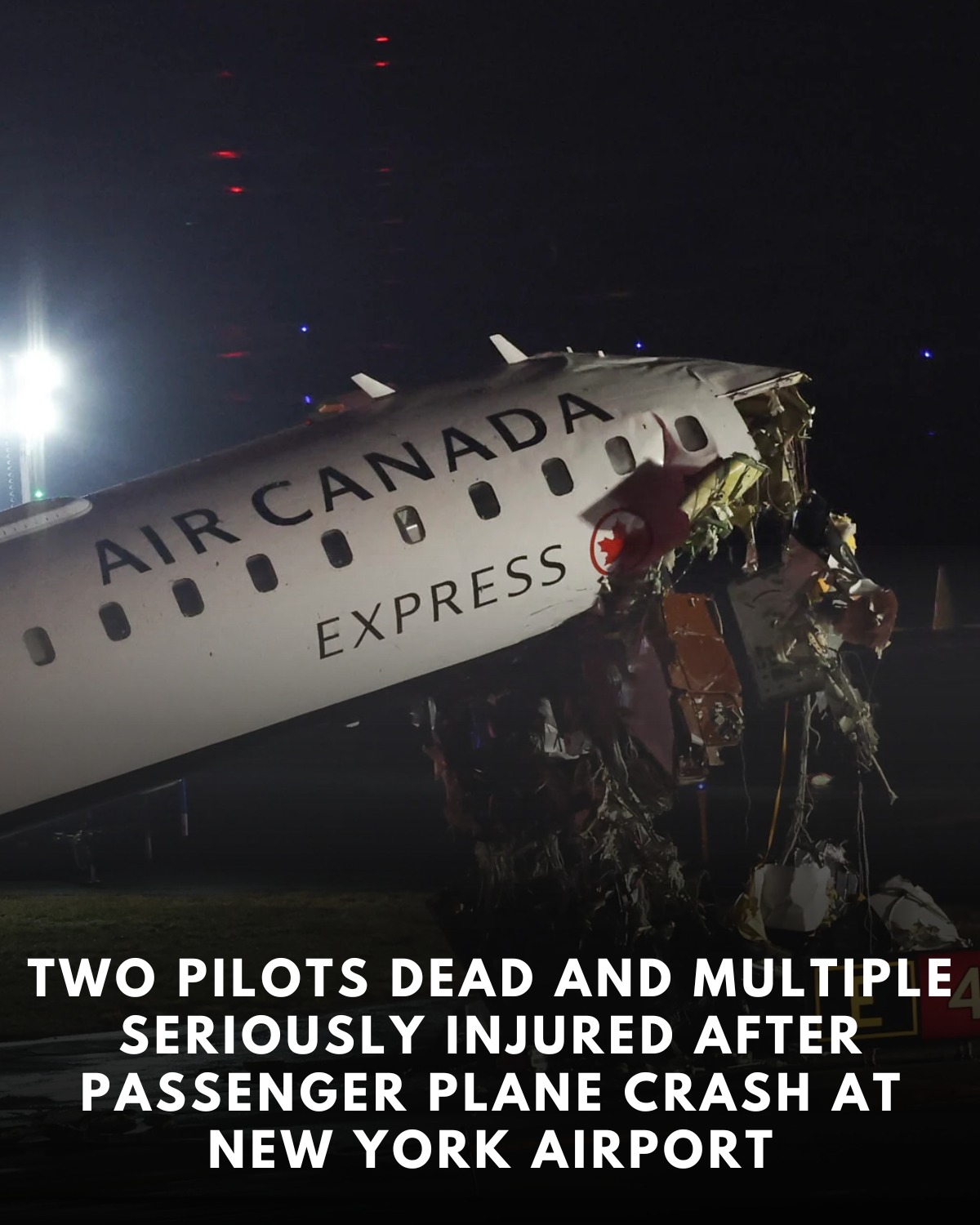
An Air Canada Express regional jet arriving from Montreal struck a Port Authority rescue and firefighting vehicle on the runway at New York’s LaGuardia Airport late on Sunday, killing the pilot and co-pilot and injuring others in a crash that shut one of the busiest airports in the United States and prompted a federal investigation.
The aircraft, a Bombardier CRJ-900 operated by Jazz Aviation on behalf of Air Canada, was operating Flight 8646 from Montréal-Pierre Elliott Trudeau International Airport to LaGuardia. Jazz said a preliminary passenger list indicated there were 72 passengers and four crew members on board, though it stressed that figure was subject to confirmation. The incident occurred at about 11:47 p.m. on 22 March, according to Jazz, while the Port Authority said the aircraft struck a rescue and firefighting vehicle that had been responding to a separate incident.
Reuters, citing NBC News and other U.S. media reporting from the scene, said the pilot and co-pilot were killed. NBC also reported that the emergency vehicle was staffed by police officers and that a sergeant and an officer suffered broken limbs and were in stable condition in hospital. The Associated Press said officials did not immediately provide a full casualty count in the early hours after the crash, underlining that some details were still emerging as emergency crews remained around the wreckage.
Images from LaGuardia showed the front of the aircraft crushed inward, with the nose pitched upward after impact, while the emergency vehicle lay overturned nearby. AP photographs showed emergency stairs brought up to the jet’s doors as passengers were evacuated. Video and images circulating from the airport showed debris scattered on the runway and a heavy emergency response around the damaged aircraft.
The collision brought operations at LaGuardia to a halt. The Federal Aviation Administration said the airport was expected to remain shut until 2 p.m. Eastern Time on Monday, while the Wall Street Journal, citing the agency, reported the closure could extend until at least 7 p.m. as investigators and emergency teams worked at the scene. Flight tracking data reviewed by Flightradar24 showed multiple diversions, with Reuters reporting that at least 18 flights were sent elsewhere or returned to their point of origin.
The National Transportation Safety Board said it was investigating the accident. A statement reported by multiple outlets said the agency was launching a go-team to examine the March 22 incident involving Jazz Aviation’s Air Canada Express Flight 8646, with Chair Jennifer Homendy expected to serve as the on-scene spokesperson. That places the inquiry among the most closely watched U.S. transport investigations, with federal officials expected to examine cockpit voice recordings, runway procedures, vehicle movements and air traffic control instructions.
Early reporting also pointed to the sequence of events immediately before the impact. Flightradar24 said the CRJ-900 landed on Runway 4 and was rolling down the runway when it struck an airport rescue and firefighting vehicle as it crossed the runway. The New York Post and other outlets, citing air traffic control audio, reported that the truck had been cleared to cross Runway 4 at taxiway D while responding to another incident, before a controller could be heard urgently telling “Truck 1” to stop. Those details have not yet been fully set out by investigators, but they are likely to form a central part of the inquiry into how an aircraft on arrival came to collide with a vehicle already in the runway environment.

The aircraft involved was operating under the Air Canada Express brand but flown by Jazz Aviation, a regional carrier owned by Chorus Aviation and one of Air Canada’s main regional partners. Jazz’s brief statement confirmed the route, the flight number and the time of the incident, but did not initially comment on casualties. Air Canada referred Reuters to Jazz’s statement while saying it was aware of the incident.
The crash is especially striking because it involved a CRJ-900, a type widely used on short-haul North American routes and familiar at airports such as LaGuardia, where regional operations form a significant part of the daily schedule. The Bombardier-built jet is designed for high-frequency city pair services and normally carries around 70 to 90 passengers depending on configuration, making it a core aircraft for cross-border routes such as Montreal to New York. Flight 8646 was one such routine service until the final moments of its arrival turned catastrophic.
Weather may also be examined. Before the collision, LaGuardia had warned of rainy and cloudy conditions that could disrupt operations, and reporting after the crash described wet conditions around the runway. There is no official finding that weather caused or contributed to the accident, but visibility, runway surface conditions and operational pressures during poor weather are all standard areas of focus in airport ground-collision investigations.
What remains unclear is the full extent of injuries among passengers and cabin crew, and whether all those on board escaped with minor injuries or whether more serious trauma will emerge as hospitals complete assessments. Reuters said NBC had reported that dozens of others were injured, while AP was more cautious in its early account and said officials had not immediately stated how many people had been hurt. That gap reflects the confusion that often follows fast-moving airfield emergencies in the hours before hospitals, airlines and investigators reconcile passenger manifests with medical reports.
By Monday morning, the main confirmed picture was of a fatal runway collision involving a commercial passenger jet and an emergency vehicle at one of New York’s main airports, a wrecked CRJ-900 sitting on the tarmac with its nose destroyed, an overturned rescue truck nearby, and federal investigators moving in to determine how the paths of the two vehicles crossed. For passengers on board Flight 8646, it was the violent end of what should have been a routine late-night arrival from Canada. For U.S. aviation authorities, it has become an urgent investigation into runway safety, ground coordination and the split-second decisions that can turn an airport response into a disaster.