You open the refrigerator, reach for a carton of eggs and pause.
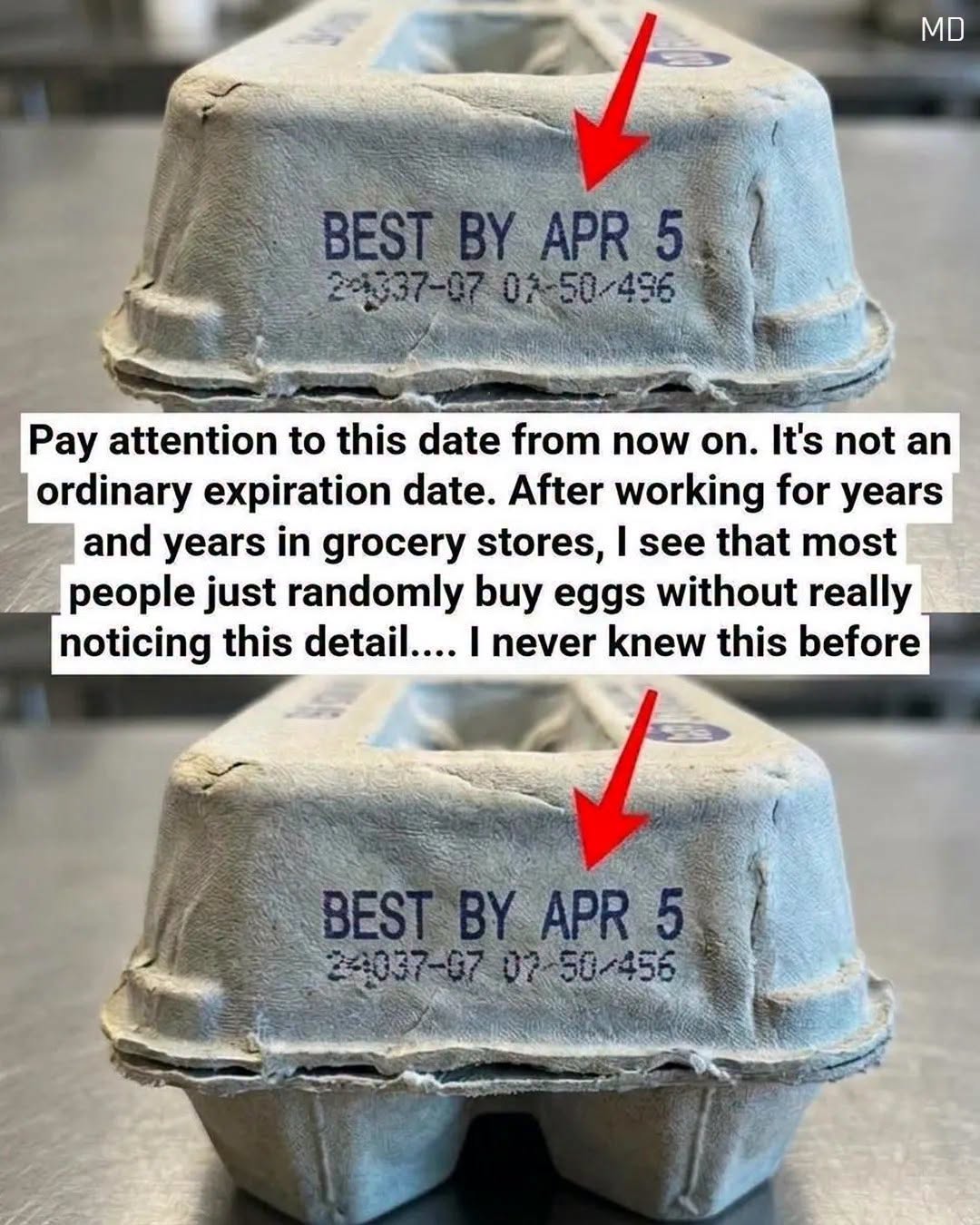
Across the package are several numbers and phrases that seem straightforward at first glance. There may be a “Best By” date, a code beginning with the letter “P,” and somewhere nearby, a strange three-digit number that looks more like a tracking code than a date.
For many shoppers, those markings are easy to interpret as expiration warnings.
But they are not all telling you the same thing.
In fact, one of the most useful numbers printed on many egg cartons is one that consumers often overlook entirely.
That three-digit number can tell you exactly when the eggs were packed.
And once you understand how the system works, reading an egg carton becomes much easier.
The Three-Digit Code Has a Specific Meaning
On many egg cartons in the United States, a three-digit number represents the pack date—the day of the year when the eggs were processed and placed into the carton.
The system uses numbers from 001 through 365, with 001 representing January 1 and 365 representing December 31 in a non-leap year.
So, for example, a carton marked 032 indicates that the eggs were packed on February 1.
A code such as 198 corresponds to July 17 in a non-leap year.
At first glance, the numbers may look meaningless. But once you know the system, they provide a useful way to determine how recently the eggs were packed.
This can be particularly helpful when you have two cartons in your refrigerator and want to know which one was packed first.
Instead of relying solely on the larger printed date, you can compare the pack codes and get a clearer picture of the eggs’ age.
But there is an important distinction shoppers need to remember.
The pack date is not the same thing as an expiration date.
That difference matters.
What Does the “P” Code Mean?
The other unfamiliar marking commonly found on egg cartons can also provide useful information.
A code beginning with the letter “P” generally identifies the processing or grading plant where the eggs were handled.
In other words, that code is primarily about where the eggs were processed—not about how long they will remain safe to eat.
Then there are the dates consumers see most often.
You may encounter phrases such as “Sell By,” “Best By,” or “Best Before.”
Although they may look similar, these labels can serve different purposes.
A “Sell By” date is largely intended to help retailers manage inventory and determine how long a product should remain available for sale.
A “Best By” or “Best Before” date is generally more closely associated with expected quality.
That means the date printed on the carton does not necessarily represent the precise moment when an egg suddenly becomes unsafe.
Food does not work like a light switch.
An egg does not magically transform from safe to dangerous at midnight on the date printed on the package.
Instead, freshness, storage conditions, handling and time all play a role.
The Refrigerator Matters More Than Many People Realize
Understanding the numbers on the carton is helpful, but proper storage is ultimately much more important.
According to USDA guidance, raw shell eggs generally keep for about three to five weeks when they are properly refrigerated at 40°F (4°C) or below.
That is why where you keep your eggs inside the refrigerator can matter.
Keeping them in their original carton on an interior refrigerator shelf helps protect the eggs from temperature fluctuations and physical damage.
The original carton also keeps the eggs organized and helps prevent them from absorbing odors from other foods.
One common mistake is treating the refrigerator door as the best place for eggs simply because many refrigerators have built-in egg holders there.
The door is exposed to repeated temperature changes every time the refrigerator is opened.
An interior shelf generally provides more consistent cold temperatures.
And that consistency is important.
Freshness and Safety Are Not the Same Thing
There is another popular trick many people use when they are unsure about an older egg: the water-float test.
The basic idea is simple.
As an egg ages, the air cell inside it becomes larger. That can cause the egg to float when placed in water.
The test can therefore give you some indication of an egg’s age or freshness.
But there is a crucial limitation.
The float test cannot tell you whether an egg is contaminated with harmful bacteria.
An egg that sinks is not automatically guaranteed to be safe, and an egg that floats is not automatically dangerous.
The test tells you something about the egg’s age—not whether it contains bacteria such as Salmonella.
That distinction is easy to overlook.
A carton code is information.
A float test is information.
Neither one is a guarantee of food safety.
Ultimately, safe handling and proper cooking practices are far more important than relying on a single clue.
What Should You Do With Cracked Eggs?
The condition of the shell is another important factor.
Eggs with cracked shells can provide bacteria with an easier route into the egg, which is why cracked or heavily contaminated eggs should be treated cautiously.
If an egg is badly cracked, dirty or otherwise appears compromised, throwing it away is often the safer choice.
And remember that the risk does not end when the egg leaves the carton.
Raw eggs can spread bacteria to hands, utensils, countertops and other foods.
That makes basic kitchen hygiene extremely important.
Wash your hands after handling raw eggs, and clean utensils and surfaces that come into contact with them.
Preventing cross-contamination can be just as important as checking the carton date.
Cooking Eggs Properly Is Another Key Step
How you cook eggs matters, too.
FDA guidance recommends cooking eggs until both the whites and yolks are firm.
That applies whether you are frying, scrambling, baking or preparing eggs as part of another dish.
Once eggs have been cooked, storage becomes the next consideration.
Cooked egg dishes generally keep for about three to four days in the refrigerator.
Hard-cooked eggs can usually be refrigerated for about one week.
The same basic principle applies: keep them properly refrigerated and avoid leaving them at unsafe temperatures for extended periods.
Food safety is not determined by one number printed on a package.
It is a combination of time, temperature, handling, storage and preparation.
So What Should You Actually Look For on the Carton?
The next time you are standing in the grocery store comparing two cartons of eggs, those mysterious markings do not have to be confusing.
The three-digit number can tell you the pack date.
The “P” code generally identifies the processing or grading plant.
A “Sell By” date is primarily useful for retailers managing inventory.
A “Best By” or “Best Before” date generally relates more closely to expected quality.
And none of those markings should be viewed in isolation from proper refrigeration and safe food handling.
The pack date can be particularly useful when comparing the freshness of different cartons.
For example, if one carton carries a lower day-of-year number than another, it was packed earlier. That can help you decide which carton to use first.
But once the eggs are home, proper storage becomes the priority.
Keep them cold.
Keep them in their original carton.
Handle them carefully.
Avoid cracked shells.
And cook them properly.
The Bottom Line
There is no reason to panic simply because an egg carton has reached one of the dates printed on it.
The important thing is understanding what that particular marking actually means.
A printed date is not necessarily an expiration date.
A three-digit code is not a random string of numbers.
And a floating egg is not a scientific guarantee that the contents are unsafe—or safe.
The numbers on an egg carton are there to provide information, but consumers still have to consider the bigger picture.
How old are the eggs?
How have they been stored?
Have they remained consistently refrigerated?
Is the shell intact?
Have they been handled safely?
And have they been cooked properly?
Those questions tell you far more about how to treat your eggs than simply staring at one date.
Once you know how to read the codes, that small carton sitting in your refrigerator suddenly becomes much easier to understand.
What once looked like a confusing collection of numbers and letters can actually tell you where the eggs came from, when they were packed and how to better organize them at home.
The key is simply knowing what you are looking at.
So the next time you reach for a carton and see a mysterious three-digit number, don’t immediately assume it is an expiration date.
It may be telling you something much more specific: the day those eggs were packed.