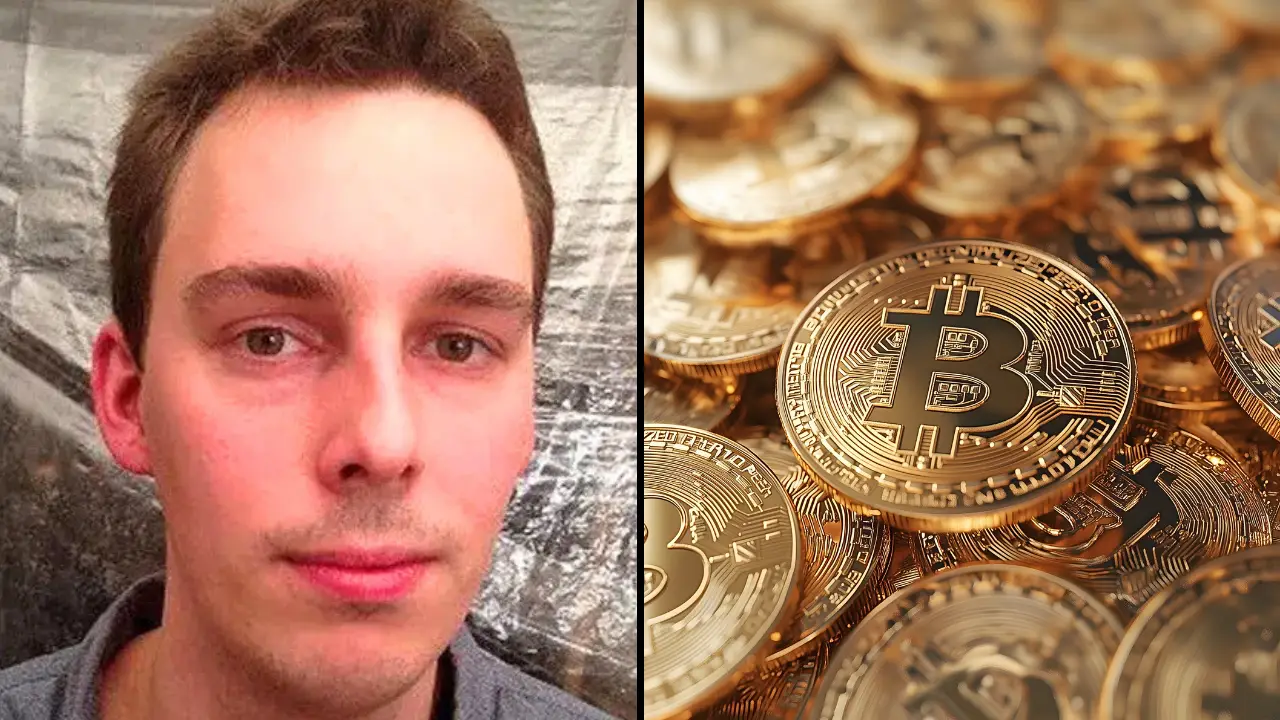
A student who forgot he invested $27 in Bitcoin returned to a huge fortune years later.
Bitcoin is a decentralized digital currency introduced in 2008 by the mysterious figure (or group) Satoshi Nakamoto, explains Investopedia.
It allows users to make peer-to-peer transactions without intermediaries like banks, using blockchain technology – a distributed, cryptographically secured ledger that records every transaction.
The Bitcoin network is maintained by miners, who compete to solve complex mathematical problems and are rewarded with new bitcoins.
While it can be mined using specialized hardware or bought on cryptocurrency exchanges in fractions, Bitcoin is also increasingly used for payments and investment.
Over time, its use has expanded from a novel payment method to a high-risk, high-reward asset class.
Bitcoin’s value has experienced extreme volatility, influenced by market trends, investor sentiment, and global events.
Though its price has seen rapid growth, particularly during speculative booms, it’s also been prone to crashes. Investors face numerous risks, including hacking, fraud, and uncertain regulatory status.
Despite these concerns, Bitcoin breached the $100,000 mark in late 2024, driven by institutional interest, ETF approvals, and political developments.
While the U.S. and other governments continue debating regulatory approaches, Bitcoin remains a foundational technology with both significant promise and persistent risks.

But in an unexpected windfall, a Norwegian man’s modest $27 investment in Bitcoin returned a surprise fortune – enough to purchase an apartment in one of Oslo’s more affluent neighborhoods.
The story, originally reported in The Guardian in 2013, has since become a legendary example of Bitcoin’s volatile yet potentially lucrative nature.
Kristoffer Koch first encountered Bitcoin in 2009 while researching encryption for his thesis.
Intrigued, he decided to invest 150 Norwegian kroner (roughly $26.60 at the time) to acquire 5,000 bitcoins.
Like many who dabbled early in cryptocurrency, he soon forgot about the purchase.
It wasn’t until 2013, when Bitcoin began receiving international media attention, that Koch was reminded of his long-dormant investment.

At the time, acquiring bitcoins typically required exchanging conventional money through online platforms like Mt. Gox, one of the most recognized exchanges.
However, concerns over regulation and anti-money laundering measures made the process complex.
Users could later convert their digital currency back into cash through similar exchanges.
Yet Bitcoin wasn’t limited to online transactions. It had started to be accepted in real-world settings, including several British pubs like the Pembury Tavern in London, The Guardian reports.
On 29 October 2013, the world’s first permanent Bitcoin ATM was launched in Vancouver, Canada, allowing users to buy or sell bitcoins using palm-scanning technology.
Another method of acquiring bitcoin was through ‘mining,’ a process where users solve complex mathematical problems using computers, earning new bitcoins in return.
However, mining became increasingly resource-intensive over time, as the difficulty of generating each new bitcoin rose, requiring more powerful hardware and significant electricity usage.

Accessing the digital wallet where Koch’s bitcoins were stored wasn’t easy.
These wallets are encrypted and protected by private keys, and Koch had forgotten the password.
After some effort to recall it, he finally gained access and discovered the full value of his holdings.
“It said I had 5,000 bitcoins in there. Measuring that in today’s rates, it’s about NOK5m ($886,000),” Koch told Norwegian broadcaster NRK.
The price of Bitcoin experienced extreme highs and lows in 2013.
In April of that year, the value soared to $266 before plunging to $50. A few months later, it rose again, reaching $197 in October, partly in response to the shutdown of Silk Road, the illicit online marketplace.
Despite these fluctuations, Koch decided to sell about 1,000 bitcoins, which provided him with enough Norwegian kroner to buy a flat in Toyen, an upscale district in Oslo.
But here’s what’s truly mind-blowing: Koch only sold off about 20% of his stash.
The rest? He’s believed to still be holding onto it, Itchebus reports.
And with Bitcoin now hovering around $80,000 per coin, that forgotten $27 has exploded into a fortune worth hundreds of millions.
“5000 BTC for $27? That’s half a billion today. That’s crazy!” wrote one commenter on Reddit.
Another added: “This story inspired me to buy my first bitcoin in 2014. I’m grateful.”