- Donald Trump declares himself ‘acting president of Venezuela’
- Trump’s Greenland plans revealed
- Russia demands Vladimir Putin ‘invades more countries’
- What countries could Trump target next?
Donald Trump has been urged to invade the UK, and five other countries at risk of US takeover have been revealed.
In an unprecedented escalation of territorial ambitions, President Trump’s second term has sent shockwaves through the international community as the United States adopts an increasingly aggressive foreign policy stance.
Following a dramatic military operation in Venezuela and persistent threats against Greenland, experts and observers are now identifying which nations could find themselves in Washington’s crosshairs next.

The Trump administration has fundamentally altered the landscape of hemispheric relations following a stunning overnight military raid that captured Venezuelan President Nicolás Maduro and his wife from their heavily fortified compound in Caracas.
The operation, which Trump described as a validation of the 1823 Monroe Doctrine, now rebranded as the ‘Donroe Doctrine,’ per the BBC, marks an audacious assertion of US supremacy in the Western Hemisphere.
Speaking aboard Air Force One, Trump justified the action as necessary to restore democracy and eliminate what he characterized as a corrupt narco-state on America’s doorstep.
The operation has drawn both praise and condemnation from international observers, with critics warning it sets a dangerous precedent for unilateral military action against sovereign nations.
The Venezuela intervention appears to have emboldened the administration’s most hawkish voices, with officials suggesting that similar operations could be justified elsewhere if US interests are deemed threatened.
This dramatic show of force has also served as a stark warning to other nations that Trump’s threats should be taken seriously.

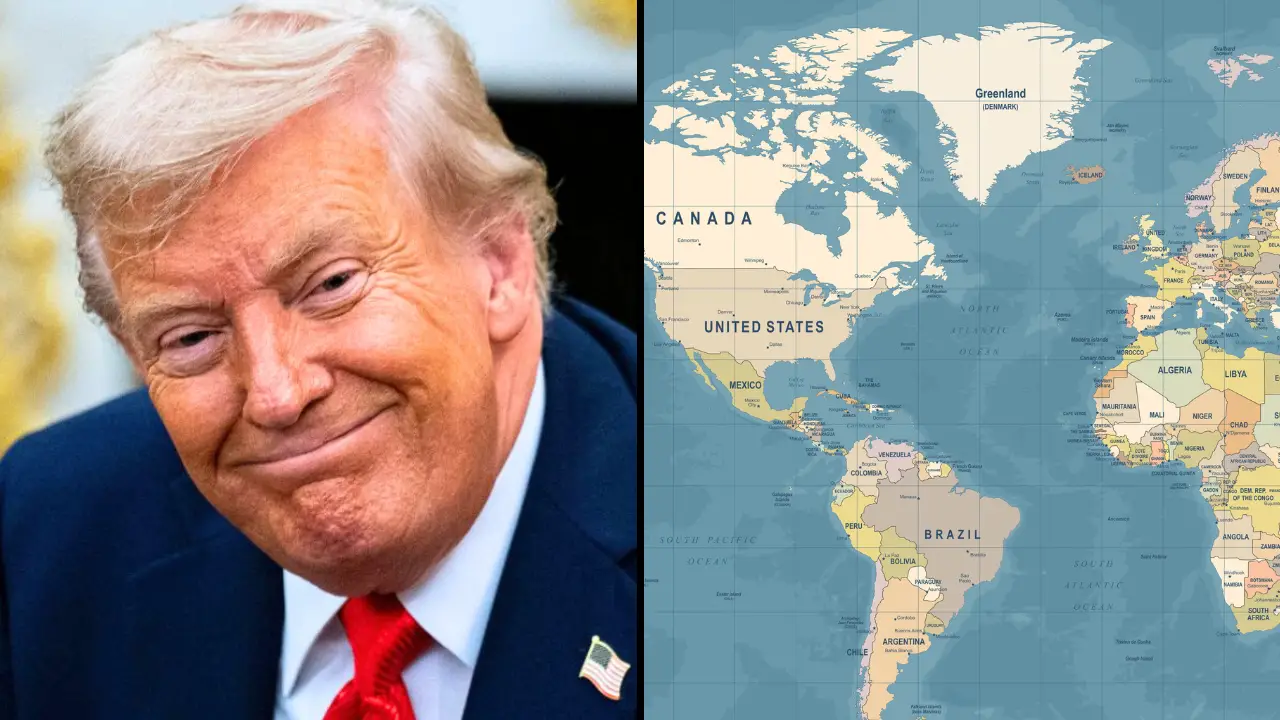
Perhaps no territorial ambition has generated more international controversy than Trump’s repeated insistence that the United States must ‘own’ Greenland.
The vast Arctic island, currently a semi-autonomous territory of Denmark, has become the focus of an elaborate strategy that security experts warn bears disturbing similarities to Russian President Vladimir Putin’s expansionist playbook.
“We need Greenland from the standpoint of national security,” Trump told reporters, claiming without evidence that the territory is ‘covered with Russian and Chinese ships all over the place.’
He ominously added that America will acquire Greenland ‘the easy way or the hard way.’
According to a detailed analysis by European officials and NATO insiders speaking to Politico, the Trump administration appears to be following a four-step strategy to bring Greenland under US control, per Politico.
The plan reportedly begins with an influence campaign designed to accelerate Greenland’s independence movement from Denmark.
Already, 56 percent of Greenlanders expressed support for independence in a 2025 poll, though 85 percent oppose becoming part of the United States.

Step two involves offering Greenland a Compact of Free Association similar to arrangements the US maintains with Pacific island nations like Micronesia and Palau.
Under such an agreement, Washington would provide essential services, protection, and free trade in exchange for unrestricted military access to Greenlandic territory.
The third phase centers on leveraging European concerns about Ukraine to gain acquiescence for expanded US presence in Greenland. One EU diplomat suggested Trump might offer firmer security guarantees for Ukraine in exchange for European acceptance of American control over the Arctic territory.
Most alarmingly, military experts confirm that if diplomatic approaches fail, the US could execute a military takeover of Greenland with minimal resistance.
Lin Mortensgaard, a researcher at the Danish Institute for International Studies, estimates US forces could seize control of the capital Nuuk ‘in half an hour or less.’ Greenland’s defenses consist of just four naval vessels, a dog-sled patrol, several helicopters, and one maritime patrol aircraft—no match for American military might.
Greenland’s party leaders have issued a joint statement demanding that ‘the US’s disregard for our country must end,’ declaring (per the BBC): “We do not want to be Americans, we do not want to be Danes, we want to be Greenlanders.”

As Trump’s territorial ambitions escalate, Kremlin propagandists have seized the moment to advocate for Russian expansion beyond Ukraine, the Express reports.
Vladimir Solovyov, one of Russia’s most prominent state television broadcasters, delivered a chilling call for Moscow to abandon international law and define new ‘zones of influence’ where anti-Russian governments will not be tolerated.
“We have to explain that the games are over,” Solovyov declared in a YouTube video posted in early January 2026. “We couldn’t care less about international laws or rules.”
He urged Putin to launch ‘special military operations in other parts of our zone of influence,’ suggesting that Russia should follow America’s apparent example of unilateral territorial expansion.
Solovyov’s remarks came as he dismissed Western concerns entirely, telling viewers: “We should stop casting pearls before swine. We could spit at what Europe thinks… we simply couldn’t care less.”
He also called for Russia to adopt a full wartime economy and prepare for prolonged conflict, warning that the nation must build an economy that can survive without oil revenue.
The broadcaster’s inflammatory rhetoric reflects growing alarm among security analysts that Trump’s aggressive posture may be emboldening authoritarian regimes worldwide to pursue their own territorial ambitions, potentially triggering a cascade of international crises.

Beyond Venezuela and Greenland, Trump has issued warnings or made concerning statements about several other nations, raising fears about which territories might face US pressure or intervention next.
Colombia appears high on the list following Trump’s blunt warning to President Gustavo Petro to ‘watch his a**.’
The President accused Colombia’s left-wing leader of ‘making c**aine and selling it to the United States,’ adding menacingly: “He’s not going to be doing it for very long.”
When asked if the US would carry out a military operation against Colombia. a country rich in oil, gold, and other natural resources, Trump replied: “It sounds good to me.”
Cuba faces an uncertain future as Trump suggested the island nation is ‘ready to fall’ following the collapse of Venezuelan oil supplies that reportedly comprised 30 percent of Cuba’s energy needs.
While Trump indicated military intervention might not be necessary, Secretary of State Marco Rubio, son of Cuban immigrants, warned Cuban officials: “If I lived in Havana, and I was in the government, I’d be concerned.”
Mexico remains a constant target of Trump’s ire over immigration and drug trafficking.
The President has repeatedly claimed Mexican authorities aren’t doing enough to stop narcotics from flowing across the border and has offered to send US troops to combat cartels, though President Claudia Sheinbaum has firmly rejected any American military presence on Mexican soil.
Trump’s first-day executive order renaming the Gulf of Mexico as the ‘Gulf of America’ signals his territorial mindset regarding America’s southern neighbor.

Iran has drawn Trump’s attention as anti-government protests intensify across the country.
The President warned that Iranian authorities would be ‘hit very hard’ if protesters are killed, stating: “We’re watching it very closely.”
This follows previous US strikes on Iranian nuclear facilities and raises the specter of renewed American military action in the Middle East.
Panama has also entered Trump’s rhetoric, with the President suggesting US interests in the Panama Canal might justify asserting greater control over the strategic waterway, though details remain vague.
As NATO allies watch with growing alarm, the international order that has prevailed since World War II appears increasingly fragile.
Denmark has warned that any military action against Greenland would spell the end of NATO, while European nations scramble to present a unified response to Trump’s territorial ambitions.
Former commander of US troops in Europe Ben Hodges cautioned that such actions could result in ‘a loss of trust by key allies’ and severely damage America’s security.
With Trump declaring that ‘when the president speaks, you should take him seriously,’ nations across the globe are left wondering whether traditional alliances and international law will prove any barrier to an administration determined to redraw the world map according to its own vision of American interests.