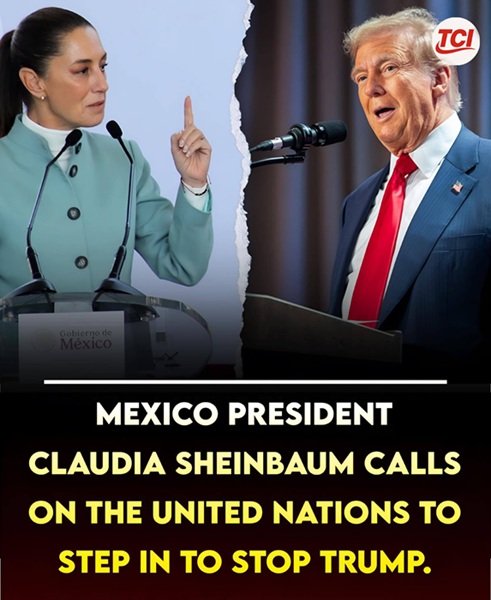
In the days following the stunning U.S. military operation in Venezuela and the capture of President Nicolás Maduro.
President Claudia Sheinbaum’s response hardened into one of the most significant critiques of U.S. foreign policy from a Latin American leader in decades.
Sheinbaum’s admonishment was not merely rhetorical. It was grounded in international law, diplomatic doctrine, and Mexico’s constitutional principles, and it immediately reshaped the diplomatic landscape in the Americas.
Sheinbaum’s government issued a forceful official communiqué condemning the U.S. operation as a unilateral breach of the United Nations Charter.
The statement explicitly referenced Article 2(4) of the Charter, which prohibits the threat or use of force against the territorial integrity or political independence of any state — a fundamental legal obligation binding on all U.N. member states.

This was not incidental phrasing: it was a legal framework deliberately chosen to elevate the dispute into the realm of global norms rather than bilateral contention.
In press briefings and formal addresses, Sheinbaum underscored that Latin America and the Caribbean are historically and legally designated as a “zone of peace” — a concept that has been repeatedly affirmed by the Mexican Foreign Ministry and regional institutions precisely to prevent foreign military intervention in hemispheric affairs.
In her view, the U.S. action represented more than a strategic strike; it signaled a dangerous erosion of sovereignty, self‑determination, and the rule of law.
Mexico’s president also called for immediate multilateral engagement. Sheinbaum urged both the United Nations (U.N.) and the Organization of American States (OAS) to fulfill their mandates — particularly in terms of defending national sovereignty and enabling peaceful resolution of disputes.
She stressed that these institutions must not be mere forums for rhetoric but active guarantors of international norms and mediators in crisis situations.
Her remarks implicitly criticized what she and other critics described as the relative inaction or paralysis of the U.N. Security Council in response to the U.S. operation, an outcome that exposes deeper structural challenges within global governance.
Sheinbaum invoked Mexico’s longstanding diplomatic traditions, such as the Estrada Doctrine — the principle that governments should not pass judgment on the legitimacy of other states’ internal affairs and should uphold non‑intervention and sovereign equality.
These principles have been at the core of Mexican foreign policy since the early 20th century and were explicitly reiterated in the official government response to the Venezuelan crisis.

Beyond legal references, Sheinbaum appealed to historical memory. She reminded audiences that Latin America has endured a long history of foreign coups, covert interference, and externally imposed regimes — episodes that have left deep scars in regional consciousness.
Sheinbaum further argued that foreign military interventions — regardless of their stated intentions — have never delivered genuine democracy, lasting stability, or well‑being.
This assessment was framed not as a defense of any particular regime but as a reflection on the historical track record of such actions in Latin America and beyond. She emphasized that true democratic self‑determination must be achieved internally, through the agency of a nation’s own people.
In political symbolism and substance, Mexico’s stance was unmistakable: the dispute over Venezuela had become a question of whether international relations in the Western Hemisphere would be governed by force or by law, respect, and diplomacy.
Sheinbaum’s choice to elevate legal principles over political alignment served as both a rebuke to Washington and a reinforcement of Mexico’s self‑defined global identity — one rooted in sovereign equality and peaceful cooperation.
Importantly, Sheinbaum also addressed practical geopolitical concerns. Her outreach to the U.N. and the OAS was paired with a clear warning that cooperation with the United States on issues like migration, trade, and security cannot come at the expense of ignoring fundamental questions of war, peace, and international order.
She framed Mexico’s cooperation as robust but principled, rejecting any notion that diplomatic or economic engagement should entail acquiescence on matters of global stability.

Mexico’s posture resonated across the region. Other governments, especially in South America and the Caribbean, expressed varying degrees of concern about the U.S. operation’s implications, contributing to wider debate and division among hemispheric powers about the limits of military action and the expectations of international conduct.
Sheinbaum’s message culminated in a poignant diplomatic assertion: in the struggle over Caracas, the region faced a larger contest over the rules that govern power, order, and cooperation in the Americas.
Whether through the U.N. Charter’s legal norms, regional cooperation frameworks, or historical memory, this moment had crystallized into a test of whether diplomacy can prevail over unilateral force, and whether regional sovereignty will be upheld in the face of great power assertions.
In the aftermath of the U.S. military operation in Venezuela and the dramatic capture of Nicolás Maduro, the diplomatic ripples extended far beyond Washington and Caracas.
Mexico, under President Claudia Sheinbaum, emerged as a prominent voice of principled opposition, asserting that the use of force against Venezuela violated not only international law but also the norms of hemispheric order that have long guided Latin American diplomacy.
Her critique was meticulously framed, combining references to global legal frameworks, historical doctrine, and regional memory, ensuring that Mexico’s stance would resonate across multiple audiences, from domestic constituents to international policymakers.
Sheinbaum’s statement was not merely symbolic; it represented a deliberate positioning of Mexico as a guardian of sovereignty and a mediator for peaceful resolution. She emphasized that the United Nations Charter’s Article 2(4) unequivocally prohibits acts of aggression against another sovereign state, noting that these principles are binding on all member states, including the United States.
In reiterating the importance of international norms, Sheinbaum underscored that unilateral military actions set a dangerous precedent for global conduct, particularly in regions with histories of foreign intervention. This framing was crucial: by anchoring her critique in law, she elevated Mexico’s objection from political opinion to a matter of international legitimacy and moral authority.

Mexico’s position was reinforced by invoking the Estrada Doctrine, a foundational element of its foreign policy for nearly a century. This doctrine emphasizes non-intervention, respect for sovereignty, and self-determination, principles that have historically guided Mexico’s interactions with both neighboring states and global powers.
Sheinbaum highlighted that the Estrada Doctrine is not simply a domestic tradition but a recognized standard of diplomatic conduct, demonstrating Mexico’s long-standing commitment to resolving conflicts through dialogue rather than coercion. By connecting contemporary events to these enduring principles, Sheinbaum reinforced a narrative of consistency, credibility, and ethical leadership.
The response also drew deeply on historical consciousness. Latin America’s memory of coups, covert interventions, and externally imposed regimes remains vivid. Countries across the region have witnessed the destabilizing effects of foreign military involvement, from mid-20th-century coups supported by global powers to modern political pressures that undermined democratic institutions.
Sheinbaum reminded her audience that these experiences are not merely historical footnotes; they continue to shape public perceptions, regional alliances, and the legitimacy of foreign policy decisions. Her framing suggested that the U.S. operation in Venezuela could revive these historical anxieties, intensifying the need for principled resistance and multilateral accountability.
In parallel with moral and legal arguments, Sheinbaum highlighted the practical and strategic risks of unilateral military action. She cautioned that such interventions often exacerbate instability rather than resolve political disputes.
In Venezuela, for example, abrupt regime changes risk humanitarian crises, refugee flows, and regional security challenges, placing additional strain on neighboring countries, including Mexico. By linking legal principle to tangible outcomes, Sheinbaum presented a comprehensive case that encompassed both normative and pragmatic considerations.
Mexico’s diplomatic outreach extended to multilateral institutions, particularly the United Nations and the Organization of American States. Sheinbaum called for active engagement from these bodies, urging them to enforce existing international norms and mediate a peaceful resolution.

She stressed that multilateral mechanisms are essential to prevent unilateral interventions from undermining regional stability, positioning Mexico as a responsible actor committed to cooperative problem-solving rather than confrontation.
This appeal also implicitly challenged the perception of power politics in the Western Hemisphere, asserting that international legitimacy depends on dialogue, law, and multilateral consensus rather than military might.
The regional impact of Sheinbaum’s statements was significant. Brazil, Argentina, and several Caribbean nations publicly expressed concern over the U.S. operation, framing it as a potential destabilizing event for the entire region. Some governments drew explicit parallels to past interventions, highlighting the long-term consequences of bypassing diplomatic channels.
This regional consensus underscored that Mexico’s critique was not isolated or idiosyncratic, but part of a broader Latin American discourse emphasizing sovereignty, legal norms, and regional cooperation. By amplifying these concerns, Sheinbaum reinforced Mexico’s role as a thought leader in hemispheric diplomacy.
Domestically, Sheinbaum’s positioning also strengthened Mexico’s identity on the international stage. By foregrounding legal norms over strategic expedience or partisan alignment, she projected an image of mature, principled statecraft.
This approach allowed Mexico to negotiate and collaborate on other issues — such as migration management, trade agreements, and security cooperation with the United States — without compromising its moral authority or sovereignty. It sent a clear message: partnership with global powers does not require acquiescence to actions that contravene international law.
Moreover, Sheinbaum emphasized the importance of Venezuelan self-determination. She rejected the notion that military capture could substitute for political legitimacy or public consent. Her remarks framed the Venezuelan situation not as a bilateral confrontation between Washington and Caracas, but as a regional and global test case:
whether the principles of international law, multilateralism, and respect for sovereignty would prevail in moments of high-stakes conflict. In doing so, she positioned Mexico as both an advocate for the Venezuelan people’s rights and a defender of systemic norms that govern global order.
The broader implications of Sheinbaum’s position are profound. The Venezuelan crisis, through the lens of Mexico’s response, highlights a fundamental struggle over the rules of engagement in the Americas.
If power is exercised unilaterally, without regard for law or regional consensus, the risk of instability multiplies. If, however, diplomacy, multilateral oversight, and respect for sovereignty guide decision-making, Latin America may reinforce its identity as a zone of peace and a region capable of addressing complex political crises through negotiation rather than coercion.
Finally, Sheinbaum’s approach underscores a new paradigm of Latin American leadership: one that blends legal rigor, historical awareness, and proactive diplomacy. By appealing to international law, citing historical memory, and urging multilateral engagement, she reinforced the principle that contemporary global challenges — including military intervention, political legitimacy, and regional stability — cannot be resolved through brute force alone.
Instead, they require a commitment to dialogue, sovereignty, and shared norms, principles that are essential for maintaining both regional order and Mexico’s stature as a principled actor on the global stage.
In this expanded context, the Venezuelan situation is no longer a localized or bilateral issue. It has become a defining moment for the Americas, testing whether legal norms, regional solidarity, and diplomatic engagement can withstand pressures from unilateral military action.
Claudia Sheinbaum’s warnings, deeply rooted in law, doctrine, and history, serve as both a moral compass and a strategic guidepost, reminding the hemisphere that sovereignty, self-determination, and diplomacy are not optional ideals but the foundation of sustainable order and legitimate power in Latin America.