The RMS Titanic’s heartbreaking sinking on April 15, 1912, still fascinates people over a hundred years later.
During its first journey from Southampton to New York, the so-called “unsinkable” ship hit an iceberg, resulting in the deaths of more than 1,500 passengers and crew members.
Even with such a massive loss of life, one disturbing question remains — why were so few bodies found in the wreckage, despite the fact that over 1,500 individuals died?
The finding of Titanic’s wreckage
After many years of searching, the Titanic’s wreck was found on September 1, 1985, lying more than 12,000 feet below the surface of the Atlantic Ocean.
After years of speculation and efforts to find it, an expedition finally managed to discover its location at an incredible depth.
It might seem odd that it took so long to locate the wreck, but the issue wasn’t that its location was entirely unknown — it was more about accurately identifying its exact position.
Deep-sea explorer Robert Ballard spent eight days looking before he finally found the R.M.S. Titanic, roughly 400 miles off the coast of Newfoundland, Canada. He was able to locate the wreckage by following debris — a technique he had first used when he discovered the Scorpion, a nuclear submarine that sank in 1968.

Ballard has talked about the moment he spotted the old ocean liner lying on the ocean floor.
“We made a promise to never take anything from that ship, and to treat it with great respect,” he shared with CBS News.
Since then, expedition teams have uncovered hundreds of artifacts, giving us a look into the past — including furniture, dinnerware, and personal items of those who tragically didn’t survive the shipwreck. However, it became evident how poorly some artifacts were preserved when the first significant expedition to retrieve items from the Titanic started in 1987.
Where did all the bodies go?
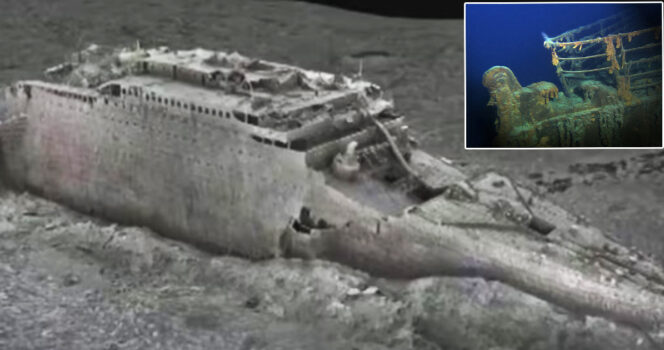
The wreck was discovered split in two, with the bow being more intact, revealing interiors that were surprisingly well-preserved after more than 70 years underwater. Surrounding the wreckage, a huge debris field measuring 5 by 3 miles was found, filled with thousands of objects scattered across the ocean floor.
But something shocking was absent: the bodies of the victims.
The lack of human remains has puzzled both historians and explorers.

While shoes, boots, and other personal belongings have been discovered in the debris, there are very few human remains to report. Out of the 337 bodies that were recovered, 119 were buried at sea, and 209 were sent back to Halifax.
“I’ve seen zero human remains,” said James Cameron, the director of Titanic, who has visited and explored the wreck 33 times and claims to have spent more time on the ship than its captain, in an interview with the New York Times in 2012. “We’ve seen clothing. We’ve seen pairs of shoes, which would strongly suggest there was a body there at one point. But we’ve never seen any human remains.”
So, what happened to the many bodies?
The answer seems to be that the Titanic wreck lies deep in the ocean—much deeper than most people think. At depths exceeding 12,000 feet, the water temperature is just above freezing, and the pressure is enormous.
Over time, these conditions have caused the bodies to be consumed by bacteria and sea creatures. The only remains that appear to survive are items like shoes and boots, as these materials are not something marine life can eat.
The role of seawater in the vanishing of bones
However, the lack of skeletons isn’t solely due to sea creatures.
Robert Ballard, the deep-sea explorer who was the first to find the Titanic wreck, explains that at such depths, seawater can actually dissolve bones. The water lacks sufficient calcium carbonate, which is a crucial part of bones. As the soft tissue gets eaten away, the bones gradually dissolve, leaving no evidence behind.
Ballard also pointed out a significant difference with the Black Sea, where there are no such creatures to consume bodies, and where the bones remain preserved in a mummified form because there’s no marine life to break them down.

“The problem you face is that at depths below about 3,000 feet, you go beneath what’s known as the calcium carbonate compensation depth,” deep-sea explorer Robert Ballard told NPR.
“And the water in the deep sea is under-saturated in calcium carbonate, which is mainly what bones consist of. For instance, on the Titanic and the Bismarck, those ships lie below the calcium carbonate compensation depth, so once the creatures consume their flesh and expose the bones, the bones dissolve.”
The unsettling truth
The finding of the wreck and its debris field has always generated a mix of wonder and fear.
People who have learned about the disappearance of the Titanic’s bodies have expressed their feelings online, with many describing it as “horrifying” or “eerie” to contemplate the thousands of lives lost and how nature has ultimately taken its course.
Yet, amidst this chilling truth, some individuals find a peculiar comfort in knowing that the bodies were returned to nature in its own manner.
In the words of one commenter, “The only solace is that those victims were returned to nature the only way Mother Nature understands.”
The slow deterioration of the Titanic
Since it was found, the Titanic has been explored many times by scientists and adventurers, with many artifacts retrieved and displayed for the public.
However, the wreck itself hasn’t been kept in perfect shape.
Over time, underwater missions have unintentionally harmed the ship, and a type of bacteria that consumes iron has been gradually eroding its hull. Experts believe that in the next 50 years, the Titanic’s structure could completely fall apart, leaving only rust and the remains of its tough interior.
A heartbreaking conclusion to a tourist venture
In 2023, the wreck became the scene of an even more recent tragedy.
The Titan submersible, run by OceanGate to offer tourists a view of the Titanic’s final resting place, sadly imploded during its descent, resulting in the deaths of all six individuals aboard.
Among those on board was the pilot Stockton Rush, co-founder of OceanGate, co-pilot Paul-Henri Nargeolet, a Titanic specialist, and three tourists: Shahzada Dawood and his 19-year-old son Suleman Dawood, both from a wealthy Pakistani business family, and Hamish Harding, a British entrepreneur and adventurer.
The enigma of the Titanic’s missing bodies is a chilling one, but it reminds us of the harsh forces of nature and the deep sorrow that still exists in the Atlantic’s depths.