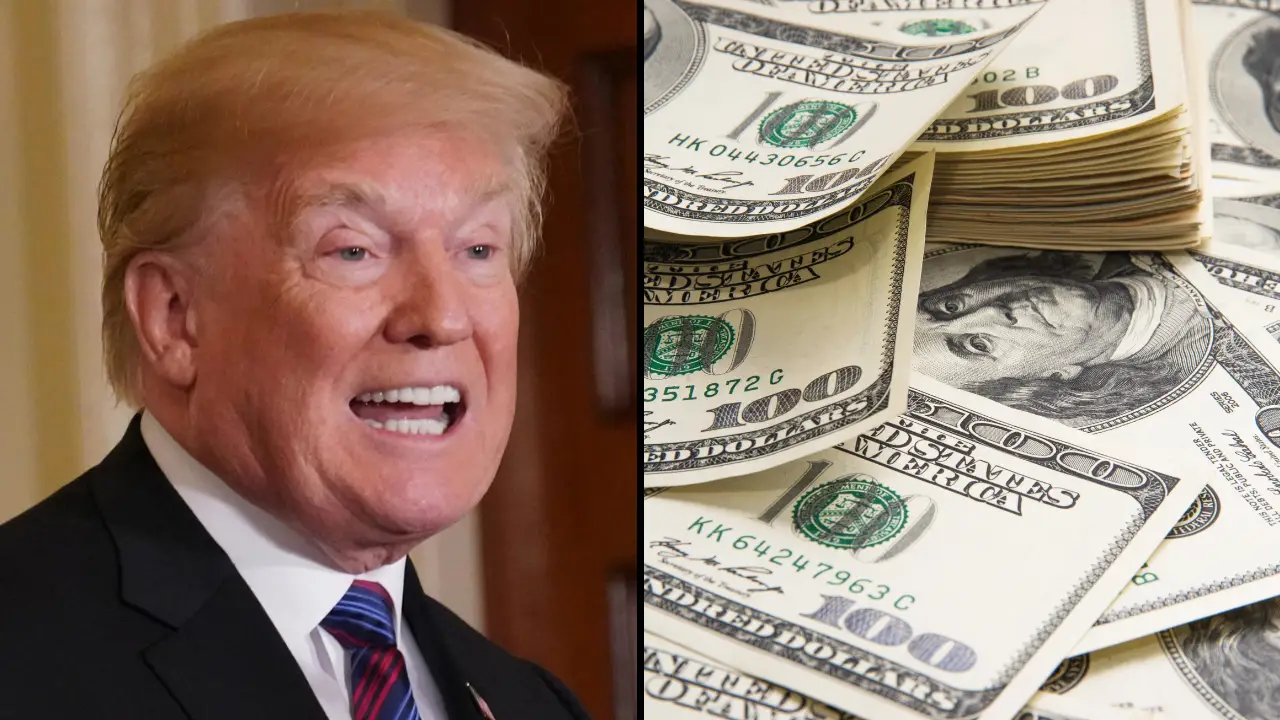
There are certain things you need to check to see if you’re eligible for the $2,000 check Donald Trump has promised Americans.
As the United States continues to wrestle with rising costs, affordability pressures, and persistent concerns about inflation, Trump has revived an idea he has floated before: giving Americans a ‘tariff rebate dividend’ of at least $2,000 per person.
He first reignited the discussion in early November, announcing on Truth Social that the massive tariff revenue collected by his administration could soon be redistributed to low-and middle-income Americans.
Trump framed the payment as a form of compensation for the higher consumer prices caused by his tariffs, which importers pay upfront but typically pass on to American households.

According to the President, the US is taking in ‘trillions of dollars’ from tariffs, enough not only to fund the $2,000 payments but also to begin paying down the country’s nearly $40 trillion national debt.
His administration previously signaled that tariff revenue would be used for tax cuts or deficit reduction, so the promise of a direct payment came as a surprise.
Since then, millions of Americans have waited for clarity on who qualifies, when the money will arrive, and whether the government can even afford to send the checks at all.
The concept behind the $2,000 payment is fairly simple in theory.
The federal government collects tariff revenue from importers that bring goods into the US Tariffs have risen sharply under Trump’s second term, applying to a wide array of goods.
The President argues that because American consumers indirectly pay for these tariffs through increased prices, they are owed a rebate funded by the money importers pay to the Treasury.
However, the execution is anything but simple.

Treasury Secretary Scott Bessent has repeatedly declined to confirm whether checks will be sent out at all, suggesting the benefit could arrive in several forms.
In multiple interviews, Bessent said that the ‘$2,000’ might instead take the form of tax reductions, such as no taxes on tips, overtime pay, or Social Security income, or new deductions on auto loan interest.
This has only further blurred the line between a cash payment and a tax break, leaving the public unsure what exactly will materialize.
Trump has also said the payments will not arrive before the 2025 holiday season.
Speaking to reporters aboard Air Force One, he stated that the funds will not be distributed in time for Christmas shopping and will instead arrive in 2026.
The timeline aligns with the lack of formal legislation or Congressional authorization, both of which would be needed before any payments could be issued.
While Trump maintains that tariff income is pouring into the US at historic levels, the numbers present a more difficult picture, CNN reports.
The administration has collected a total of about $220 billion in tariff revenue, including funds from tariffs that predate Trump.
If all 163 million Americans who filed tax returns in 2024 each received $2,000, the total cost would exceed $326 billion.
Even excluding high-income Americans would leave the program costing around $300 billion, still far higher than available revenue.
Some estimates suggest the real cost could reach $600 billion, depending on how many Americans qualify and whether dependents are included.

In contrast, the new tariffs implemented in April have raised only about $90 billion so far, creating a vast funding shortfall.
Trump insists tariff revenue will ‘skyrocket,’ claiming importers are currently stockpiling goods to avoid future tariff hikes, but economists and tax-policy experts remain skeptical that tariffs could ever generate enough money to cover the promised payments.
Another major complication comes from the US Supreme Court, which is reviewing whether Trump’s use of emergency powers to impose many of his tariffs is lawful.
Approximately $100 billion in tariff revenue was collected using these emergency authorities.
If the Court rules against the administration, that money may need to be reimbursed to businesses, dramatically reducing the pool available for rebates and potentially derailing the entire payment proposal.

Even if the revenue problem could somehow be solved, Trump is unlikely to issue the payments by executive action alone.
Congress, not the President, controls federal spending. All previous stimulus payments, including those sent during the pandemic, required Congressional authorization.
While stimulus checks have historically been popular, they have almost always been tied to recessions or emergency conditions. The current economy does not meet those criteria.
Some lawmakers have already expressed concerns that sending $2,000 checks could worsen inflation at a time when Americans are struggling with rising prices.
Injecting hundreds of billions of dollars into the economy could cause a short-term boost but might also force the Federal Reserve to raise interest rates again, something neither consumers nor investors want.
Fiscal conservatives within Trump’s own party may therefore oppose the plan, reducing the odds of Congressional approval.

If Congress approves the program, distribution could follow a model similar to past federal payments.
During the pandemic, some Americans waited nearly 20 weeks for physical checks to reach their mailboxes.
With no legislation drafted and multiple legal obstacles still unresolved, 2026 appears to be the earliest realistic timeframe for any payments, assuming they are approved at all.
Despite the confusion surrounding the plan, one thing has become increasingly clear: eligibility will almost certainly revolve around income.
Trump has repeatedly emphasized that ‘high income people’ will not receive the $2,000, while those with ‘moderate income’ will qualify.

Treasury officials and several policy experts have used past stimulus thresholds as reference points. According to Social Security analyst Blind to Billionaire, who reviewed Trump’s statements and existing federal benefit models, the most likely income cutoff mirrors previous stimulus programs.
Individuals earning below $75,000 per year would qualify, while married couples filing jointly would need to earn below $150,000 to be eligible.
While the administration has not confirmed whether children or dependents will receive payments, the current guidance strongly suggests that adults within these income limits are the intended recipients.
Ultimately, the most important factor will be your latest filed tax return, which the government will almost certainly use to determine eligibility.
The payment may arrive as a check or may take the form of tax relief, but based on everything known to date, Americans earning under $75,000 as individuals or under $150,000 as married couples stand the best chance of receiving the promised $2,000, if the proposal becomes a reality at all.