
Doctor issues urgent warning over ‘free bleeding’ after rapper admits to doing it onstage
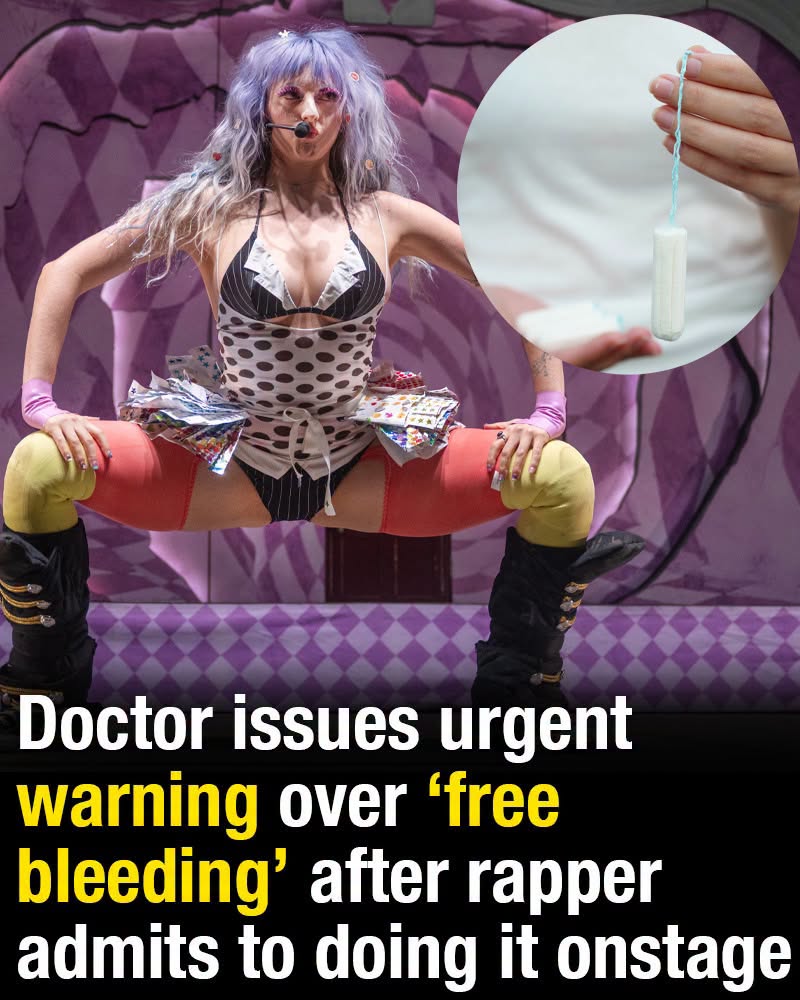
An American rapper sparked an unexpected conversation about menstruation after telling a packed festival crowd that she might “free bleed” onstage when she realized her period was about to begin.
The comment quickly spread across social media, where it triggered sharply divided reactions. Some applauded the performer for speaking openly about something that is still often treated as embarrassing or inappropriate to discuss in public. Others questioned whether menstrual bleeding belonged on a concert stage at all.
But beyond the debate over whether people should be comfortable talking about periods in public, medical professionals say there is another part of the conversation that should not be overlooked: hygiene and exposure to blood still matter.
For generations, menstruation has largely been managed privately, with products such as pads and tampons becoming a routine part of everyday life. In more recent years, menstrual cups, period underwear and other reusable products have expanded the options available to people who menstruate.
Now, however, a practice that removes many of those barriers has once again found itself in the spotlight.
It is known as “free bleeding.”
What Is Free Bleeding?
Free bleeding generally refers to menstruating without using products such as tampons, pads or menstrual cups to collect menstrual blood.
Although the practice is sometimes portrayed as a modern social-media trend, the concept is hardly new.
For most of human history, people who menstruated did so without access to the modern sanitary products that are common today. Free bleeding also became associated with feminist activism, particularly during the 1970s, when concerns surrounding tampons and toxic shock syndrome helped fuel wider discussions about menstrual health and the products used to manage periods.
Today, however, the reasons people choose to free bleed can be very different.
For some, it is a deliberate rejection of the shame and secrecy that have historically surrounded menstruation.
For others, it is simply about comfort.
Some people find tampons, pads or other menstrual products uncomfortable, irritating or inconvenient, while others see free bleeding as a way of challenging the idea that menstrual blood should always be hidden.
There can also be a financial motivation.
According to the Consumer Healthcare Products Association, women in the United States collectively spend around $3 billion a year on menstrual products.
For someone who regularly purchases tampons and pads, avoiding those products can reduce expenses. For some activists, it also forms part of a broader criticism of the so-called “pink tax,” a term commonly used to describe higher prices associated with certain products marketed toward women.
But while menstrual blood itself is not inherently dirty, medical professionals emphasize that avoiding menstrual products does not mean avoiding hygiene.
Is Free Bleeding Actually Safe?
According to Katherine Murad, a physician assistant specializing in gynecology, free bleeding itself is generally considered safe.
However, problems can arise when menstrual blood remains against the skin for extended periods without proper cleaning.
“There’s a mild risk of infection if menstrual blood gets left on your skin for long periods without cleaning,” Murad told the Cleveland Clinic. “But as long as you’re cleaning yourself appropriately, the risk is minimal.”
The issue is not necessarily the menstrual blood itself.
Instead, prolonged exposure to moisture can contribute to irritation and create an environment where bacteria can build up.
That can become particularly uncomfortable during a heavier period.
For that reason, maintaining basic hygiene remains important for anyone who chooses to free bleed. Changing wet clothing, washing regularly and keeping the skin clean and dry can help reduce irritation and discomfort.
There is another consideration when menstrual blood comes into contact with shared surfaces.
As Dr. Susanna Unsworth pointed out, menstrual blood is still blood. Like other blood, it can potentially carry bloodborne infections.
That does not mean menstrual blood should be considered dirty or dangerous, and medical professionals caution against reinforcing the stigma that menstruation is somehow unhygienic.
But it does mean that blood should not unnecessarily be exposed to other people.
Surfaces that come into contact with blood should be cleaned and disinfected appropriately.
In other words, free bleeding does not automatically mean something is medically dangerous — but it also does not eliminate the need for basic hygiene and consideration for other people.
Then Ashnikko Took the Conversation to the Stage
The debate became considerably more public when American rapper Ashnikko, whose real name is Ashton Nicole Casey, brought the subject directly into one of Europe’s biggest music festivals.
The 30-year-old performer was appearing at Sziget Festival in Budapest when she realized that her period might be about to start.
Rather than quietly leaving the stage or ignoring the situation, Ashnikko decided to tell the audience.
According to clips shared online, she addressed the crowd and said:
“Just so everyone knows, I feel like I’m right about to start my period, so if I’m free bleeding at any point on this stage, respect and love.”
She then asked the audience to “send hearts” her way.
The moment could have ended there.
Instead, Ashnikko turned it into an impromptu chant.
“Free bleeding in Budapest!” she sang three times, before adding that it would be “so cute.”
The crowd appeared to embrace the unusual moment, with the performer treating menstruation as something that did not need to be hidden or whispered about.
But once videos of the incident began circulating online, the response became far less unanimous.
Social Media Divides Over the Comment
Some people were openly critical of the rapper.
One person on X questioned why Ashnikko needed to tell the audience about her period at all, while another commenter responded with an even harsher criticism, suggesting she should simply have been given a tampon and different clothes.
The comments reflected a familiar attitude toward menstruation: the idea that periods should remain private and that audiences should not be exposed to discussions — or the possibility of visible evidence — of menstrual bleeding.
But others strongly defended Ashnikko.
Supporters argued that menstruation is a completely natural biological process and questioned why people continue to react with such disgust toward menstrual blood.
One commenter wrote that the audience had actually been “meant to free bleed,” while another argued that menstrual blood is among the cleanest forms of blood and criticized the level of disgust directed toward it.
The reactions highlighted just how divided people remain over the subject.
For some, free bleeding represents freedom from the stigma surrounding menstruation.
For others, it raises legitimate questions about hygiene, shared spaces and whether personal bodily functions need to become part of a public performance.
The Bigger Conversation About Periods
Ashnikko’s comments may have been delivered as a spontaneous moment during a concert, but the reaction shows that menstruation remains a surprisingly controversial subject.
Periods are a normal biological process experienced by millions of people, yet conversations about them can still provoke embarrassment, disgust or discomfort.
Free bleeding has become one way some people challenge those attitudes.
At the same time, medical professionals emphasize that removing menstrual products does not mean abandoning hygiene. People who choose to free bleed still need to pay attention to cleanliness, skin irritation, clothing and the environments around them.
Ultimately, whether someone chooses to use a tampon, pad, menstrual cup, period underwear — or no menstrual product at all — is a personal decision.
The medical advice is less about judging the choice and more about understanding the practical risks.
And Ashnikko’s unexpected announcement in Budapest has certainly succeeded in doing one thing: getting people talking.
The question now is whether free bleeding should be viewed primarily as a personal choice and a rejection of menstrual stigma, or whether there are situations — particularly shared public spaces — where hygiene and consideration for others should take priority.
You may also like
I Married My Fiancée Even After Doctors Said She Had Only a Month to Live – After Her Funeral, Her Lawyer Told Me, ‘She Left Something for You and Made Me Promise to Give It to You After She Was Gone’
The house had never been this quiet. I moved through the rooms like a shadow, barely aware of where my…
Sally Field’s worst on-screen kiss might be a surprise
Born into a working-class show-business family in Pasadena, California, she experienced difficult circumstances growing up. In her memoir, Field revealed…
Young boy attacked by three sharks in Bahamas after tourists threw food in water
The family had traveled to The Bahamas for a holiday that included several popular tourist activities, including an excursion to…