
Man who won lottery 14 times explains simple math he used to hack the system
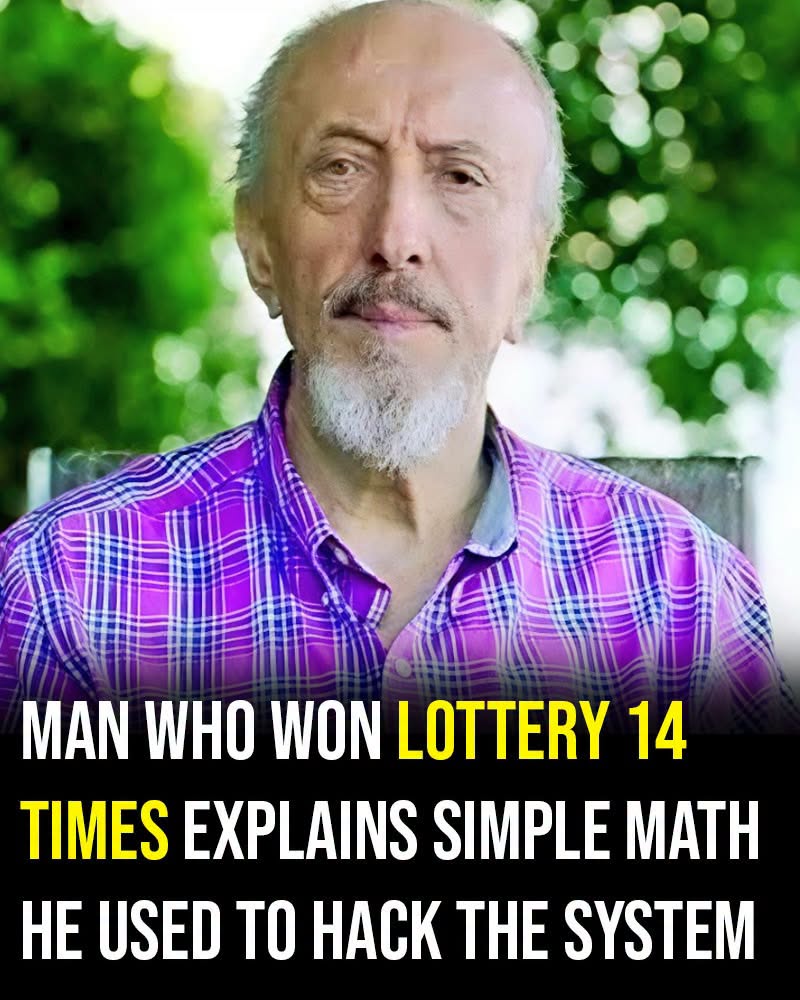
Winning the lottery is supposed to be the ultimate game of chance. Millions of people buy tickets, choose their numbers and hope that, against extraordinary odds, their combination will be the one that changes their lives forever.
But Romanian-born mathematician Stefan Mandel looked at the lottery differently.
Rather than relying on luck, Mandel studied the mathematics behind the games and discovered a way to dramatically improve his chances. His strategy was not based on predicting winning numbers or finding a secret combination. Instead, it involved something much simpler — covering as many possible combinations as possible.
The approach was so successful that Mandel and the lottery syndicates he organized eventually won money from lottery games 14 times.
For the average lottery player, Mandel’s story sounds almost impossible.
Consider the odds of winning the Mega Millions jackpot, which are approximately 1 in 302.5 million, according to UNILAD. Those numbers make the prospect of hitting the jackpot extraordinarily unlikely for an individual player.
Mandel, however, realized that there was another way to look at those enormous odds.
Instead of asking, What are the chances that my ticket wins? he effectively asked, What would happen if I could buy enough tickets to cover every possible combination?
That simple change in perspective became the foundation of his remarkable lottery strategy.
Who Is Stefan Mandel?
Mandel was a mathematician who understood that lotteries were governed by combinations and probability rather than mystery.
His strategy centered on purchasing enough tickets to cover every possible number combination in a particular lottery. On paper, the concept was relatively straightforward. In reality, putting it into practice required enormous amounts of money, careful organization and a large number of people willing to invest.
Mandel began by bringing together groups of investors who pooled their money into lottery syndicates.
The idea was simple: instead of one person buying a handful of tickets and hoping for a miracle, a large group could combine its resources and purchase a huge number of tickets.
The more combinations they covered, the greater their chances of securing the winning combination.
Mandel’s first major success brought the group around $19,000. Mandel himself received just under $4,000.
By today’s standards, that may not sound like a life-changing lottery fortune. But for Mandel, the win was far more important than the amount of money he personally collected.
It proved that his mathematical approach could work.
And he was only getting started.
From Romania to Australia
Mandel eventually moved to Australia with his family, where he continued developing his lottery strategy.
He founded the International Lotto Fund, or ILF, and began organizing larger-scale lottery operations.
The syndicate went on to participate in lotteries across several countries, including Australia, Romania and the United States.
The operation was far more complicated than simply buying a few tickets.
Mandel and his investors had to raise enormous amounts of capital, calculate the available combinations, organize ticket purchases and make sure the numbers were covered as efficiently as possible.
The goal was not necessarily to win every time.
Instead, the strategy was designed to create situations in which the potential payout could justify the enormous cost of purchasing large numbers of tickets.
A Lottery Strategy That Worked 14 Times
Mandel’s syndicate did not win the jackpot every time it played.
But over the years, the strategy generated substantial returns and eventually produced lottery wins 14 times.
That level of success naturally attracted attention.
What had started as a mathematical experiment had become something much bigger, and authorities began taking an interest in Mandel’s activities.
International agencies, including the CIA and FBI, reportedly became suspicious of the operation and investigated Mandel and his associates.
The questions surrounding his strategy were understandable. How could one man repeatedly win a game that was designed to be almost entirely based on chance?
But Mandel’s answer was mathematics.
Ultimately, Mandel and the International Lotto Fund were cleared of the crimes they had been accused of.
However, the legal battles came at a significant financial cost.
Years of investigations, court proceedings and legal expenses placed enormous pressure on Mandel’s finances.
Although he was eventually acquitted, his financial situation continued to deteriorate.
The $27 Million Jackpot
Mandel’s most remarkable success came in 1992, when his syndicate won a jackpot worth approximately $27 million.
It was the kind of victory that appeared to validate everything he had been working toward.
But just three years later, in 1995, Mandel declared bankruptcy.
The irony was striking.
A man who had managed to turn lottery mathematics into a highly successful strategy had nevertheless ended up in serious financial trouble.
His story did not end there.
Mandel subsequently spent years involved in various alleged investment schemes, adding another complicated chapter to a life already filled with extraordinary highs and dramatic setbacks.
The Mathematics Behind the Strategy
At the heart of Mandel’s system was an algorithm he called “combinatorial condensation.”
The basic principle was to purchase enough tickets to cover every possible combination in a lottery.
Imagine, for example, a lottery in which the total number of possible combinations was small enough that someone could theoretically purchase every one of them.
If a person or group had enough money to buy every combination, they would be guaranteed to possess the winning numbers.
Of course, there was a major catch.
Buying every possible combination could cost an enormous amount of money.
The strategy only made financial sense when the jackpot was large enough, the number of combinations was manageable, and the potential payout outweighed the cost of purchasing the tickets.
Mandel’s genius was not simply in understanding probability. It was in recognizing when the mathematics could potentially make the risk worthwhile.
He effectively transformed the lottery from a game based almost entirely on hope into a calculation involving combinations, costs and expected returns.
The Rules Eventually Changed
Mandel’s success did not go unnoticed.
As lottery operators became aware of strategies that could exploit the structure of certain games, new restrictions were introduced.
In the United States, lottery rules were changed to make it much harder for players to purchase tickets in enormous quantities and to use computer-generated systems to replicate strategies like Mandel’s on the same scale.
Those changes effectively closed the door on the approach that had made Mandel famous.
The circumstances that allowed his strategy to work became increasingly difficult to reproduce.
That means today’s lottery players cannot simply copy Mandel’s method, buy a large number of tickets and expect the same results.
The lottery has evolved, the rules have changed, and modern jackpots often involve vastly larger numbers of possible combinations.
From Luck to Mathematics
Stefan Mandel’s story remains one of the strangest chapters in lottery history.
He did not discover a magical sequence of numbers. He did not predict the future. And he did not somehow eliminate chance from the lottery.
Instead, he looked at the numbers differently.
While ordinary players focused on finding the right numbers, Mandel focused on how many combinations existed and whether it was possible to cover enough of them to create a mathematical advantage.
That distinction was crucial.
His approach ultimately allowed him and his syndicates to collect lottery winnings 14 times, turning a game that millions viewed as pure luck into something resembling a giant mathematical puzzle.
But Mandel’s story also comes with an important lesson: even a strategy built on mathematics is not the same as a guaranteed path to wealth.
The costs, legal battles and financial problems that followed his biggest successes showed just how complicated the reality could become.
Mandel may have found a way to bend the odds in his favor, but he could not completely escape the risks that came with trying to beat the system.
Today, the rules make his famous strategy far more difficult — and in many cases impossible — to reproduce.
Still, his legacy remains remarkable.
For most people, the lottery is a game of luck.
For Stefan Mandel, it was a numbers game.
You may also like

I Married My Fiancée Even After Doctors Said She Had Only a Month to Live – After Her Funeral, Her Lawyer Told Me, ‘She Left Something for You and Made Me Promise to Give It to You After She Was Gone’
The house had never been this quiet. I moved through the rooms like a shadow, barely aware of where my…

Sally Field’s worst on-screen kiss might be a surprise
Born into a working-class show-business family in Pasadena, California, she experienced difficult circumstances growing up. In her memoir, Field revealed…

Young boy attacked by three sharks in Bahamas after tourists threw food in water
The family had traveled to The Bahamas for a holiday that included several popular tourist activities, including an excursion to…