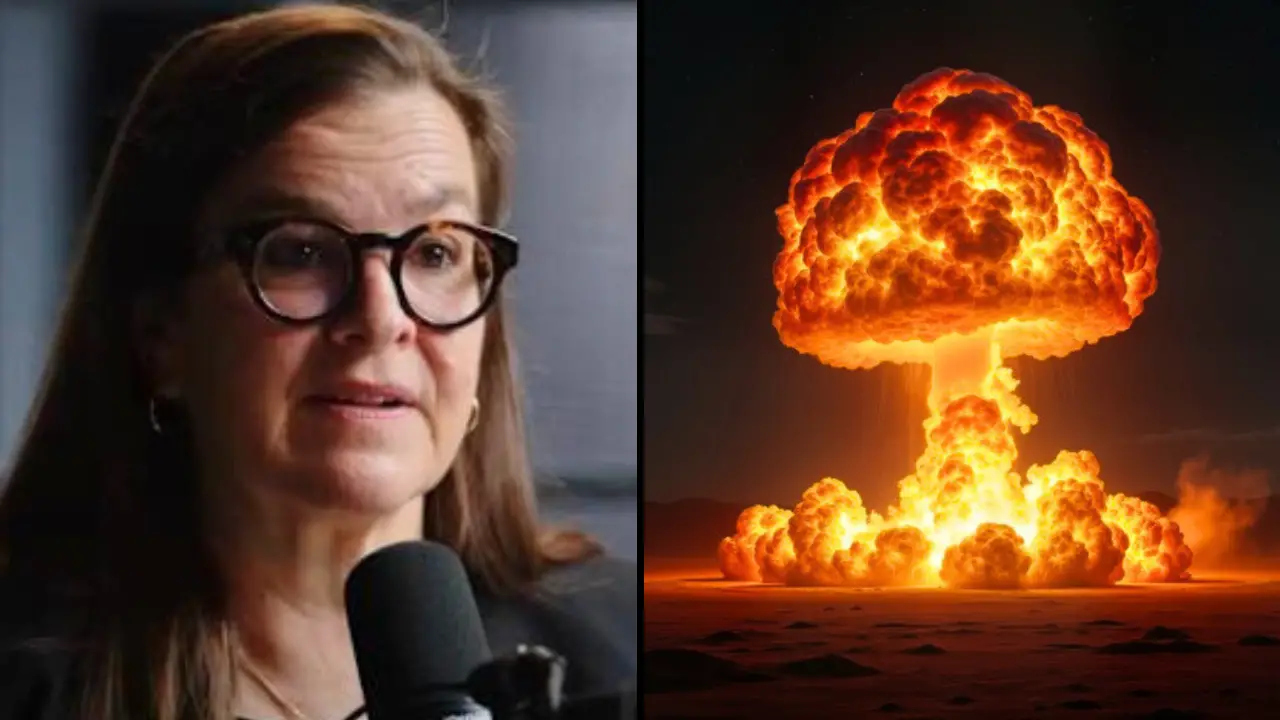
Experts have revealed the only two places that would keep you safe during a nuclear war.
As global tensions continue to rise, particularly in the Middle East, concerns over the potential for nuclear conflict have intensified.
According to investigative journalist Annie Jacobsen, there are only two places on Earth that might offer safety and sustainability in the aftermath of a nuclear war.
The concerns are not hypothetical. Escalating conflict between Iran and Israel, along with U.S. military involvement, has sparked fears that a broader war involving nuclear-armed allies like Russia and China could be imminent.
Both nations have already issued warnings that American intervention might trigger a global catastrophe.

Speaking on The Diary of a CEO podcast, Jacobsen explained that Southern Hemisphere nations would be among the few regions capable of supporting agriculture following a nuclear catastrophe.
“Places like Iowa and Ukraine would be just snow for 10 years. So agriculture would fail, and when agriculture fails, people just die,” she warned.
The combination of environmental collapse and radiation poisoning would make life uninhabitable across most of the Northern Hemisphere.
Jacobsen described a bleak scenario, explaining that due to the destruction of the ozone layer, ‘you can’t be outside in the sunlight.’
The surviving population would likely be ‘forced to live underground, fighting for food everywhere except for in New Zealand and Australia,’ she said.
Jacobsen’s book, ‘Nuclear War: A Scenario,’ explores this possibility in detail.
“Hundreds of millions of people die in the fireballs, no question,” she said during her podcast appearance.
She also referenced a 2022 study by Professor Owen Toon, published in Nature Food, which updated the concept of nuclear winter, per MailOnline.

According to that research, a full-scale nuclear exchange could result in five billion deaths due to agricultural collapse and mass starvation.
Nuclear winter, a term popularized in 1983 by scientist Carl Sagan, refers to the dramatic global cooling that would result from widespread fires caused by nuclear explosions.
The smoke would rise into the stratosphere, where it could linger for years, blocking sunlight and dropping temperatures drastically, by as much as 40°F in the U.S., Jacobsen noted.
Podcast host Steven Bartlett reflected on a recent visit to Australia, saying: “So there’d be three billion people still alive. Where shall I go to be one of the three billion? I was just in New Zealand and Australia.”
Jacobsen responded: “That’s exactly where you’d go. According to Toon, those are the only places that could actually sustain agriculture.”
Australia and New Zealand’s geographical isolation, distance from major nuclear powers, and protective oceanic currents position them as potential refuges from radioactive fallout.
For those unable to relocate, however, the renewed threat of nuclear conflict has sparked interest in fallout shelters across the U.S. – structures that, while not blast-proof, can offer some protection from radiation.
To be effective, they must feature thick, protective walls, proper ventilation systems, and sufficient supplies to support survivors for extended periods.
Related Article: Russia Warns Donald Trump That He Has Opened ‘Pandora’s Box’ With Strikes On Iran
Related Article: Every Citizen Who Would Be Safe From Getting Drafted If U.S. Went To War