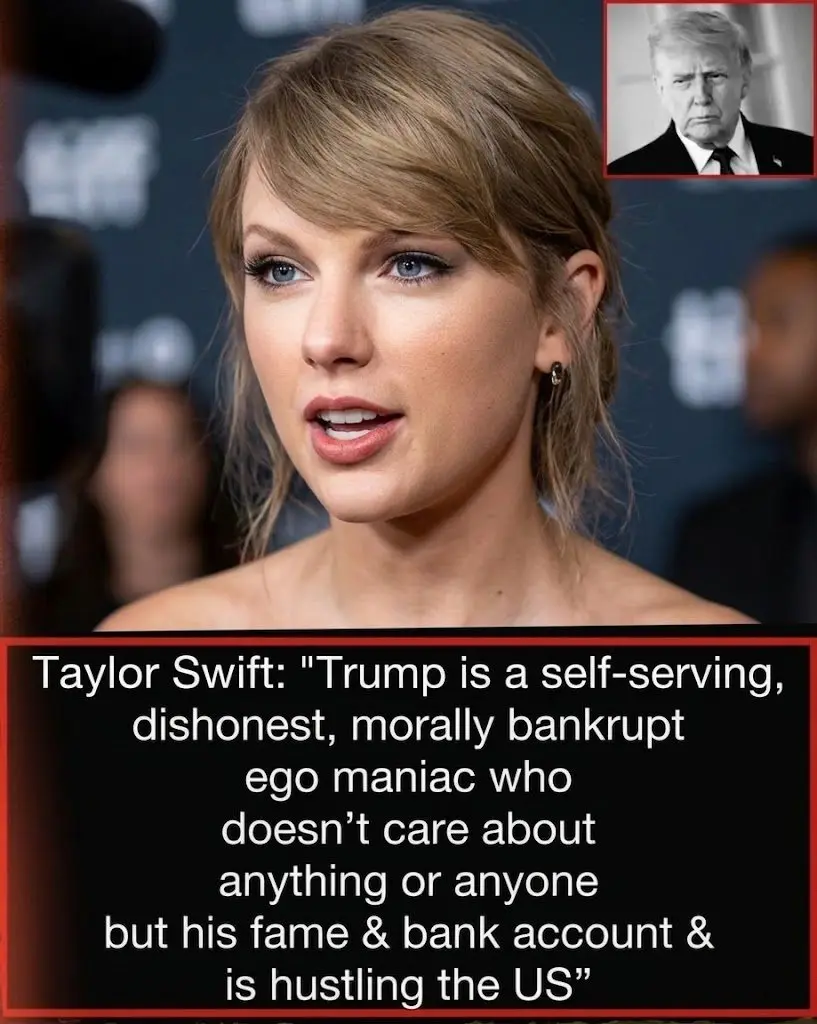
Pop superstar Taylor Swift is once again at the center of a political firestorm after explosive remarks attributed to her about former President Donald Trump began spreading rapidly across social media. The statement, which accused Trump of being “self-serving, dishonest, morally bankrupt,” immediately ignited fierce debate online and intensified the already growing divide between celebrity influence and American politics.
According to posts circulating online, Swift allegedly described Trump as “an ego maniac who doesn’t care about anything or anyone but his fame and bank account,” while also accusing him of “hustling the US.” The comments, whether viewed as courageous political criticism or inflammatory rhetoric, quickly became one of the most discussed celebrity controversies of the week.
Supporters of Taylor Swift praised the singer for speaking openly and forcefully about her political beliefs at a time when many celebrities continue to avoid direct confrontation. Across platforms like X, TikTok, Instagram, and Facebook, fans defended Swift’s right to express concern about leadership, morality, and the future direction of the country.
“Taylor is saying what millions of Americans feel,” one supporter wrote online. “She’s not afraid of backlash anymore.”
Others argued that Swift’s influence gives her a unique platform to encourage civic engagement and political participation, particularly among younger Americans who closely follow her every move. Political analysts have repeatedly pointed to Swift’s enormous cultural reach, noting that even brief comments from the singer can dominate headlines for days and dramatically influence online conversations.
But critics reacted just as strongly.
Trump supporters immediately pushed back against the remarks, accusing Swift of using her fame to attack conservatives and deepen political division in the United States. Some described the comments as disrespectful, while others argued celebrities should avoid inserting themselves into political debates altogether.
“She’s a singer, not a political expert,” one user posted. “Hollywood elites think they speak for everyone.”
The controversy quickly escalated as clips, screenshots, reaction videos, and edited commentary flooded social media. Several political commentators and entertainment personalities weighed in, turning the moment into a broader cultural debate about celebrity activism, free speech, and the increasingly blurred line between entertainment and politics in America.
This is far from the first time Taylor Swift has become involved in political discussions. Over the past several years, the global music icon has gradually become more vocal about social issues, voting rights, political leadership, and public policy. While she once avoided political commentary almost entirely, Swift’s public stance evolved significantly, particularly during recent election cycles.
Her critics argue that celebrity political messaging can oversimplify complex national issues, while supporters insist public figures have every right — and perhaps even a responsibility — to use their platforms to speak about issues they believe matter deeply.
The latest backlash highlights just how polarized the American political climate has become. In today’s media environment, even a single sentence from a major celebrity can instantly trigger nationwide arguments involving politics, culture, identity, and public influence.
Entertainment industry observers also noted how rapidly the controversy spread beyond Swift’s core fanbase. Within hours, major political discussion pages, celebrity gossip outlets, and reaction channels began covering the story extensively. Hashtags connected to both Swift and Trump surged across multiple platforms, with millions engaging in heated discussions over whether celebrities should openly challenge political figures so aggressively.
Some fans admired Swift’s willingness to risk criticism by refusing to soften her language. Others warned that increasingly hostile political rhetoric from both celebrities and politicians may only fuel further division among Americans already exhausted by years of political conflict.
Meanwhile, Trump supporters online rallied around the former president, portraying the controversy as another example of mainstream entertainment figures targeting conservatives. Several users accused Hollywood celebrities of being disconnected from ordinary Americans and argued that political attacks from celebrities often strengthen Trump’s support rather than weaken it.
Neither Taylor Swift’s representatives nor Trump’s team immediately provided additional clarification regarding the viral statement, but that did little to slow the online storm. Debate surrounding the remarks continued intensifying throughout the day, with supporters and critics dissecting every word.
For many observers, the moment symbolizes something much larger than a disagreement between a pop star and a political figure. It reflects the growing reality that celebrity culture, political identity, and social media outrage are now deeply interconnected in modern America.
Whether viewed as fearless honesty or unnecessarily provocative rhetoric, one thing is undeniable: Taylor Swift’s words once again captured the attention of millions and reignited one of the most emotionally charged political conversations in the country.
And as reactions continue flooding across the internet, the divide between entertainment and politics appears smaller than ever before.