
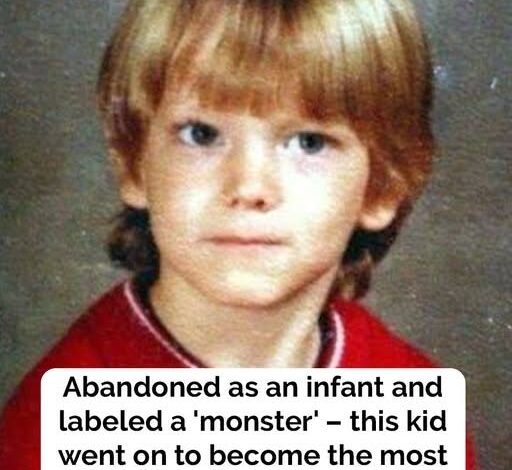
Before he became a global icon, a multi-platinum pioneer, and a legend who forever altered the landscape of hip-hop, he was just a terrified little boy surviving a living nightmare. Abandoned by his father as an infant and subjected to unspeakable abuse, neglect, and harrowing school violence by a mother wrapped in drug addiction, his earliest years were nothing short of a horror story. Branded a monster and beaten nearly to death in school bathrooms, most children would have vanished into the darkness forever. Instead, he forged his pain into a weapon of mass creative expression, rising from the ashes of public housing to conquer the world against impossible odds.
Born Marshall Mathers in St. Joseph, Missouri, his entry into the world offered little hint of the monumental legacy he would build. His father vanished when he was still an infant, leaving behind empty promises and sporadic, hollow phone calls that only deepened the boy’s sense of abandonment. Raised primarily by his mother, Debbie, family life was characterized by perpetual instability. Financial desperation forced them to constantly uproot their lives, bouncing back and forth between Missouri and the bleak public housing projects of Detroit.
This transient lifestyle stripped away any chance of a stable childhood or lasting friendships. Because they were often the only white residents in predominantly Black neighborhoods, Mathers became an immediate, vulnerable target for relentless bullying. He changed schools two or three times every single year, enduring a daily gauntlet of terror in hallways and locker rooms. The abuse reached a catastrophic peak when he was nine years old. While playing a game of King of the Hill, a vicious bully struck him in the face with a snowball packed with a heavy piece of ice. The unprovoked assault left him beaten unconscious, suffering a severe concussion and temporary blindness in one eye. His mother launched a desperate legal battle against the school system, but the suit was ultimately dismissed, leaving the young boy to heal without justice or real protection.
Yet the schoolyard was only half the battleground; home offered no sanctuary. Mathers grew up enduring a toxic environment marked by his mother’s struggles with alcoholism, marijuana use, and prescription drug abuse. As he grew older, he alleged that she even stole his hard-earned paychecks. The household dynamic was explosive, and years later, the friction boiled over into public view. Mathers immortalized his agony in raw, unfiltered lyrics, famously accusing his mother of subjecting him to Munchausen syndrome by proxy on his 2002 hit track Cleanin’ Out My Closet. He rapped about being forced to believe he was sick when he was perfectly healthy, laying bare the psychological warfare of his youth.
His mother fiercely denied the allegations, firing back with a defamation lawsuit and claiming her son was a hateful, defiant child whom she never physically punished. Despite the legal crossfire and public mudslinging, the damage to Mathers’s core was already done. But salvation was waiting in the rhythm and poetry of an emerging art form.
At the age of 14, Mathers discovered rapping, a passion that consumed him entirely and eventually led him to drop out of the traditional classroom setting. He adopted the moniker Eminem and began channeling his decades of suppressed rage, abandonment, and trauma into verses that resonated with terrifying authenticity. In 1995, he dropped his first single and simultaneously welcomed his first daughter, Hailie, with his longtime partner, Kim Scott. Standing at the threshold of fatherhood, Eminem made a fierce, unshakeable vow: his children would never experience the terror, poverty, and emotional starvation that defined his own upbringing.
The road to the summit was far from smooth. In 1997, Kim left him and took their daughter, plunging the young artist into a destructive spiral of substance abuse and depression. Yet, from the depths of that darkness, his creative genius sparked. Catching the attention of hip-hop legend Dr. Dre, Eminem signed a life-changing contract and released The Slim Shady LP. Their collaborative lightning strike on the track My Name Is catapulted him into superstardom, changing the trajectory of music history forever.
His life story was further cemented in popular culture with the 2002 semi-autobiographical blockbuster film 8 Mile, in which he starred. The movie resonated universally, earning him an Academy Award for Best Original Song for Lose Yourself—making him the first rap artist to ever win the prestigious award. Throughout his legendary career, he has continuously stripped away his armor to share his vulnerability with millions of fans across the globe, proving that trauma, when confronted, can be transformed into timeless art.
Today, Eminem stands as a devoted father of three—raising biological daughter Hailie, along with adopted daughters Alaina Marie Scott and Stevie Laine Scott. Having largely stepped away from the blinding glare of the constant spotlight, he lives a quiet, low-key life, occasionally returning to drop music collaborations that remind the world of his unmatched lyrical prowess. His mother passed away in 2024, following the death of his estranged father five years prior, closing a complex, painful chapter of generational struggle.
With iconic anthems like Mockingbird, The Way I Am, Rap God, Not Afraid, Criminal, Without Me, ‘Till I Collapse, Stan, and Lose Yourself cemented in music history, Eminem is universally celebrated as one of the greatest rappers of all time. His harrowing journey from an abused, isolated child in the projects of Detroit to a global cultural titan serves as an enduring testament to human resilience. It stands as proof that no matter how dark a beginning might be, the human spirit possesses the extraordinary power to rewrite its own ending.